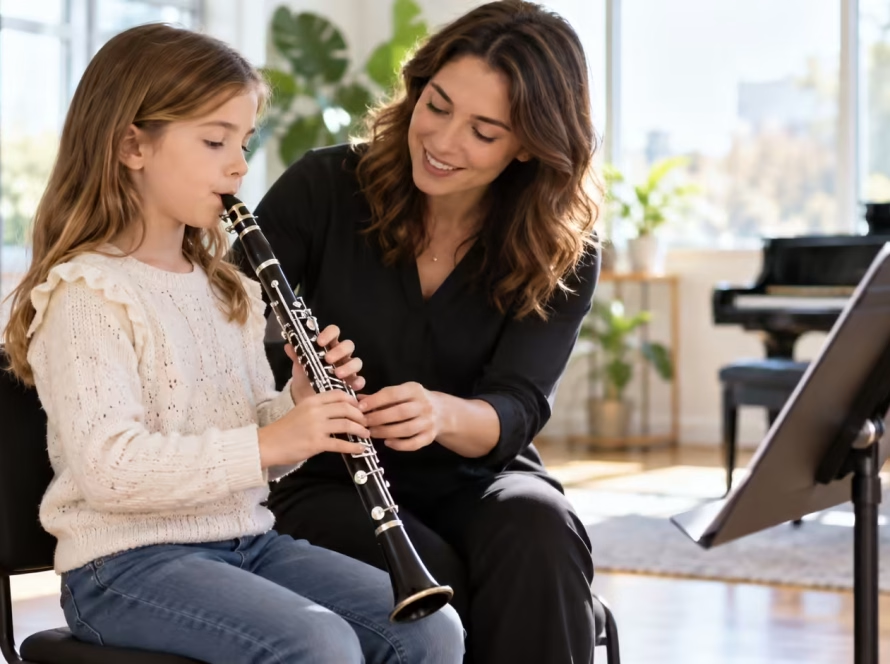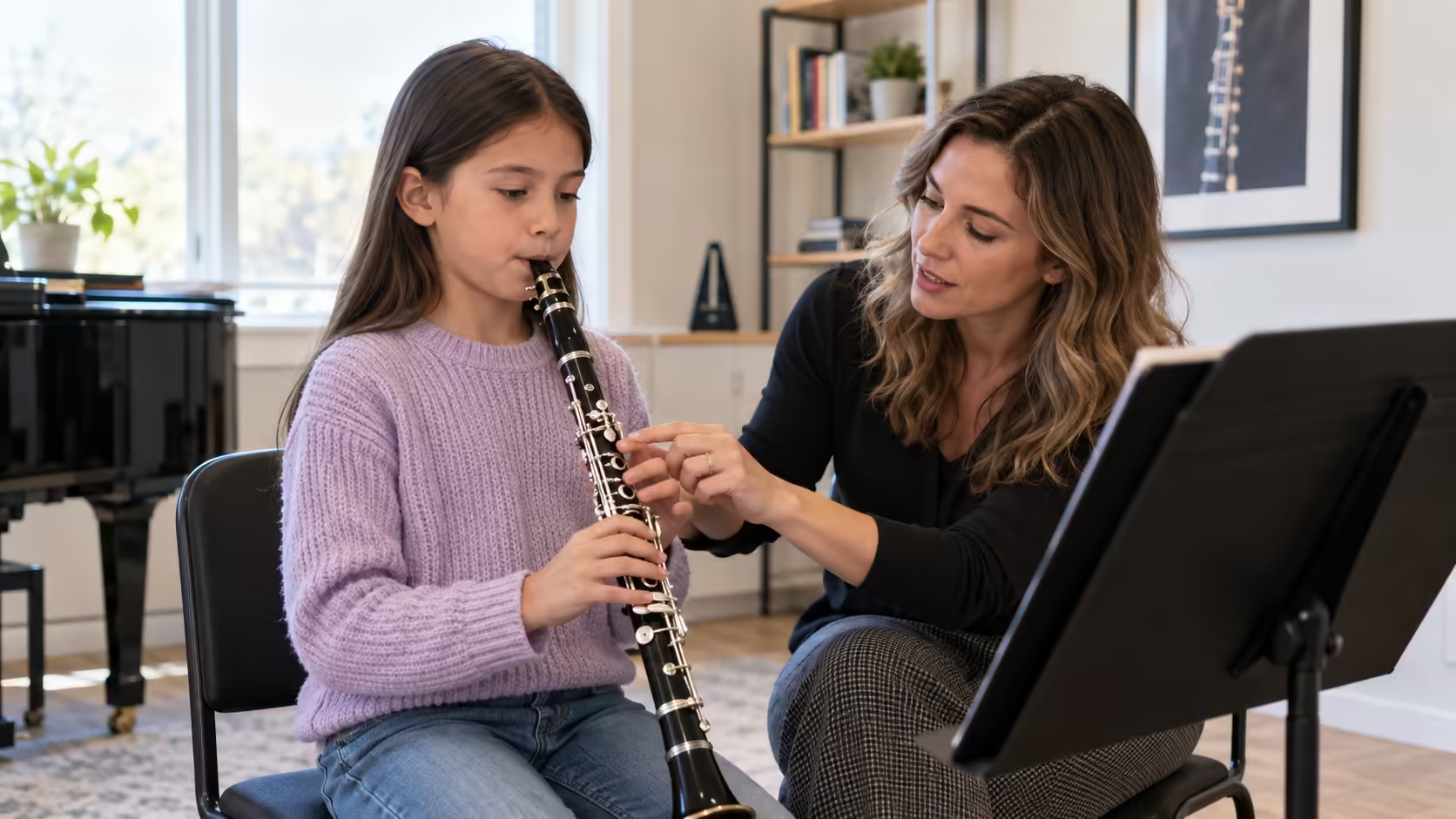

Short answer: How much do clarinet lessons cost in San Diego? Private lessons generally run $55 to $110 per lesson depending on length, or roughly $230 to $450 per month for weekly instruction. Group classes are a separate product at $20 to $50 per class.
Then come the costs no price list mentions. Reeds, a rental, books, and repairs add $30 to $60 a month, and many schools charge an annual registration fee on top.
The number that actually matters is not the per-lesson rate. It's the twelve-month total with every fee included — and that's the question most studios will not answer directly.

The Short Answer: Average Clarinet Lesson Prices in San Diego
You found a teacher you like. Now you want to know what it actually costs before you commit. Fair enough — so here is the number first, and the reasoning after.
For weekly private instruction in San Diego, CA, most families land in this range:
| Lesson length | Per lesson | Per month (weekly) | Best suited to |
|---|---|---|---|
| 30 minutes | $55–$85 | $230–$340 | Young beginners, ages 8–11 |
| 45 minutes | $65–$95 | $260–$380 | Teens, adults, band students |
| 60 minutes | $75–$110 | $300–$450 | Advanced players, audition prep |
| Group class | $20–$50 | $80–$200 | Absolute beginners, budget starts |
San Diego sits a little above the national average for music lessons, and the reason is simply the cost of living here. Rent on a studio in Mira Mesa or UTC is not what rent costs in Ohio.
However, the sticker price is the easy part. Four factors move it up or down, and we'll take each one in turn:
- Lesson length — 30, 45, or 60 minutes
- Teacher experience — a college music major and a career clarinetist are not priced alike
- Format — private, group, in-home, or online
- Location — coastal neighborhoods cost more than inland ones
One more thing worth knowing up front. Most San Diego music schools bill monthly rather than per lesson, so compare monthly totals when you gather quotes. Per-lesson math makes two studios look closer together than they really are.
Clarinet Lesson Cost in San Diego by Lesson Length
Lesson length is the single biggest driver of price. Longer lessons cost more per session but usually less per minute, which matters more than most families realize.

Teens and adults generally get more out of 45 or 60 minutes than out of a 30-minute slot.
30-Minute Clarinet Lessons: $55–$85
This is the standard starting point for young beginners. A half hour matches the attention span of an eight- or nine-year-old fairly well, and it keeps the monthly commitment manageable while you find out whether the interest will stick.
The limitation is real, though. Thirty minutes covers a warm-up, one technical idea, and one piece. There is no room for much else.
45-Minute Clarinet Lessons: $65–$95
For teens, band students, and adult clarinet players, this is usually the sweet spot. There is time to warm up properly, work on tone and technique, and still make progress on repertoire in the same session.
Notice the per-minute math as well. Moving from 30 to 45 minutes adds 50% more lesson time for roughly 15% more money at most San Diego schools.
60-Minute Clarinet Lessons: $75–$110
Advanced students need the full hour, and so does anyone preparing for honor band, all-state auditions, or college applications. More challenging clarinet pieces demand time for slow work, and slow work is exactly what gets cut when the clock runs out.
Always compare cost per minute, not sticker price
Some studios price strictly by the clock, so doubling the lesson time exactly doubles the fee. Others discount longer lessons, charging maybe $70 for 30 minutes and $90 for 60.
That second structure gives you a far better rate per minute on the longer lesson. Divide the fee by the minutes before you decide anything — it takes ten seconds and it sometimes changes the answer.
Private vs. Group Clarinet Lessons: A Real Price Gap
Here is where a lot of online price guides mislead people. They average private and group rates together and publish a range like "$25 to $85 per lesson." That blended number is useless, because those are two different products.
What group clarinet classes cost
Group classes in San Diego run roughly $20 to $50 per class, or about $80 to $200 a month. The teacher splits attention across several students, so the per-student cost drops sharply.
Group classes do real work. Beginners learn note reading, rhythm, and basic fingerings perfectly well in a small group, and playing alongside other kids is genuinely motivating.
What private clarinet lessons cost
Private lessons run $55 to $110 per lesson. You are buying the teacher's undivided attention for the whole session, and on clarinet that matters more than on most instruments.
Why? Because the two hardest things about starting clarinet — embouchure and air support — are invisible and individual. A teacher has to watch your specific mouth and listen to your specific tone to fix them. In a class of eight, that correction comes once a month instead of once a week.
Group classes save money and build ensemble skills. They are a good first step for an unsure beginner.
Private lessons move faster and catch bad habits before they harden. Once auditions, chair placement, or serious repertoire enter the picture, one-on-one time stops being optional.
Plenty of families do both: school band for ensemble experience, private lessons for technique.
6 Things That Change What You Pay
Clarinet lesson prices are not random. Six factors explain almost all of the variation you'll see in San Diego.
Teacher experience and credentials
Think of it as a ladder. College music students charge the least. Working gig musicians sit in the middle. Credentialed private teachers with years of studio experience charge more, and musicians who perform with professional symphony orchestras charge the most — sometimes well over $120 an hour.
Private, group, in-home, or online
Format changes the price more than anything except length. In-home lessons add a travel fee of $10 to $30 per visit. Online lessons often shave something off the rate because the teacher saves the drive.
Where you are in the county
Coastal and central neighborhoods — La Jolla, Del Mar, Coronado, downtown — run highest. Carlsbad, Encinitas, and Poway sit in the middle. El Cajon, Santee, Chula Vista, and Escondido tend to run lowest. A short drive can save $40 or $50 a month.
Time of day
Everyone wants the 4:30 PM slot on Tuesday. Some teachers charge a premium for peak after-school hours, and some discount mornings and early afternoons to fill the schedule. Adult students have a clear advantage here.
Registration and membership fees
Many San Diego music schools charge a registration or membership fee on top of tuition, commonly $45 to $95. Watch whether it is one-time or annual, because an annual fee quietly raises your real rate every single year.
How the month is billed
Four-week months and five-week months are the fee structure nobody reads. Some studios bill a flat monthly rate regardless. Others charge per lesson, so four months a year cost 25% more than you budgeted.
How Clarinet Lesson Cost Changes as You Improve
Your rate tends to climb as your skills grow. That sounds unfair until you look at what you're buying at each stage.
Beginners
A beginner needs the fundamentals: how to assemble the instrument, how to form an embouchure, how to make a sound that isn't a squeak, and how to read the notes on the page. A capable teacher with solid beginner experience handles all of that well.
Typical range: $55 to $85 for 30 minutes.
Intermediate players
Now the work shifts. Scales at tempo, tone control across registers, articulation, and band audition preparation. Teachers with real performance experience become genuinely more useful here, because they can demonstrate what they're asking for.
Typical range: $65 to $95 for 45 minutes.
Advanced players
At this stage you want a specialist. Someone who has coached all-state auditions, who knows the standard concerto repertoire, and who understands what college clarinet professors listen for in a recorded audition.
Typical range: $90 to $150+ per hour.
Yes, that last jump is steep. Consider the alternative math, though: one focused session with an audition coach can redirect a year of unfocused practice. Measured against a year of wasted effort, it's cheap.
Clarinet vs. Flute, Violin, Cello, and Piano: What Lessons Cost
Families comparing musical instruments for a beginner usually assume the lesson rates differ a lot. In practice they barely do. At most San Diego music schools, a clarinet lesson, a piano lesson, and a violin lesson cost the same — the teacher's time is the product.
The real differences show up in gear. Here's how the instruments compare on total first-year cost:
| Instrument | Rental / purchase | Ongoing supplies | Notes on total cost |
|---|---|---|---|
| Clarinet | $20–$40/mo rental | Reeds $20–$35 per box | Cheap to rent, but reeds never stop |
| Flute | $20–$40/mo rental | Almost none | Usually the cheapest woodwind to maintain |
| Saxophone | $35–$60/mo rental | Reeds $25–$45 per box | Bigger instrument, bigger rental and reeds |
| Violin | $20–$45/mo rental | Strings, rosin, bow rehair | Growing kids need a series of sizes |
| Cello | $40–$80/mo rental | Strings can top $100/set | Highest rental of the strings; needs space |
| Piano | Keyboard $200–$800 | Tuning if acoustic | One purchase, then almost nothing |
| Guitar | $120–$400 to buy | Strings $8–$15/set | Cheapest entry of the group |
Flute, clarinet, and trumpet are the three instruments most school band programs steer beginners toward, largely because the rentals are affordable and the parts are written for players who started last September. Clarinet in particular has an enormous amount of beginner-friendly band repertoire.
If you're weighing clarinet against guitar lessons or piano lessons purely on budget, piano and guitar win on gear. On lesson rates, everything is close to even.
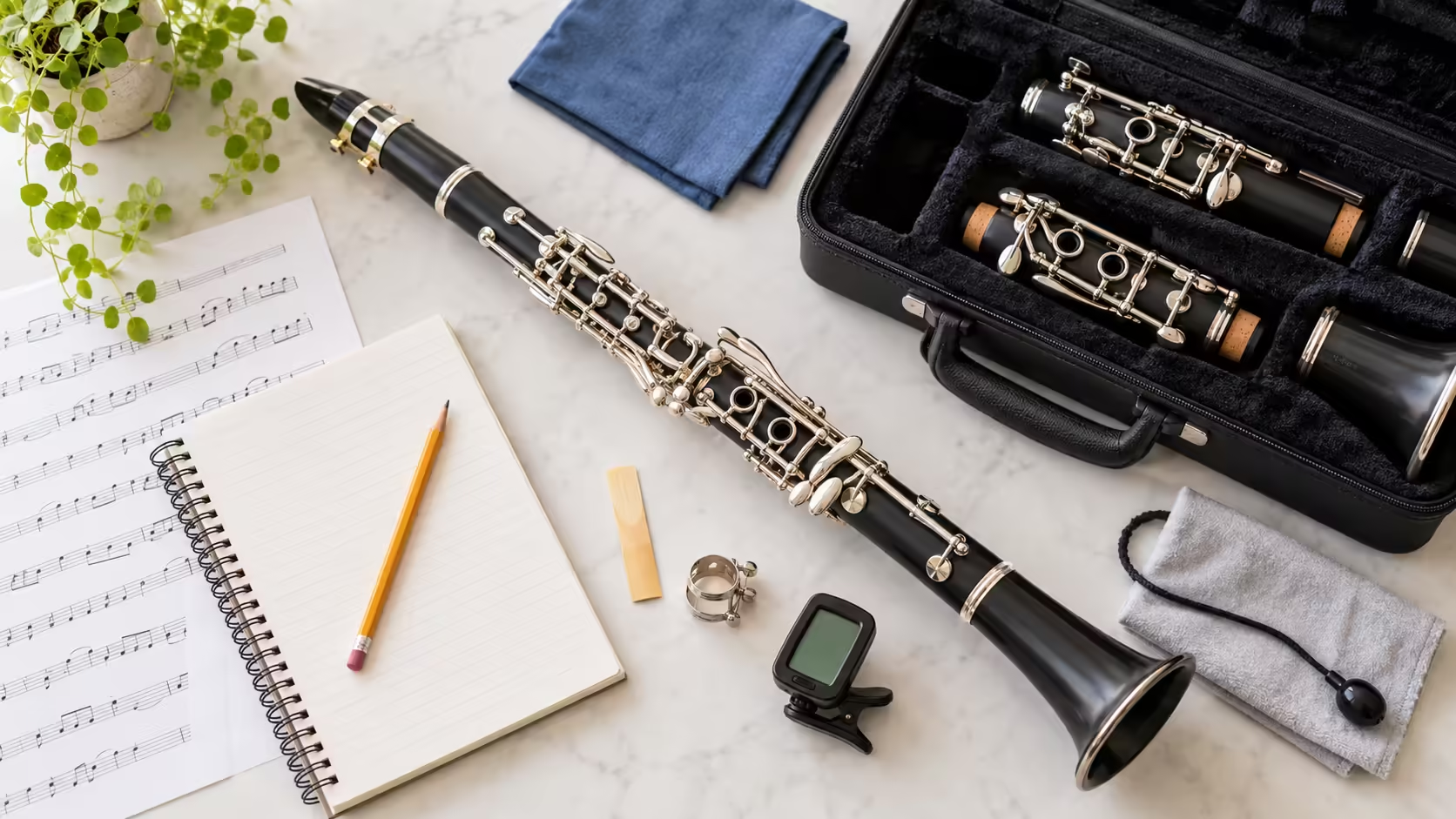
Online vs. In-Person Clarinet Lessons: Which Costs Less?
Online lessons are usually somewhat cheaper, and there's no travel fee or drive time. That said, the savings are smaller than most people expect, and clarinet is a harder instrument to teach on camera than piano or guitar.
What you give up on video
A teacher fixing your tone needs to see the corner of your mouth and hear the actual color of the sound. Compression flattens tone, and a laptop camera rarely shows hand position clearly. For an eight-year-old who needs hands-on correction, in-person wins outright.
Where online genuinely works
Intermediate and advanced students do fine online, because they already have a functioning embouchure and can describe what they're feeling. Adults do well too. And if the specialist you want lives in another city, video is the only way you're studying with them.
The cost of convenience
Most people forget to price their own time. A 20-minute drive each way adds 40 minutes to every lesson, plus gas and parking. Over a school year that's roughly 25 hours in the car.
A hybrid schedule works well for busy families: mostly online lessons, with one in-person session a month to check posture, hand position, and tone up close. You keep the cost down and still get eyes on the physical fundamentals.
How to Spend Less Without Learning Less
If the budget is tight, you still have real options. Some of these are better than paying full price for a mediocre teacher.
Start with school band
Public school band is free or close to it, and it is a genuinely good foundation. Students read music, play in an ensemble, and perform. Most programs start around 4th or 5th grade — NAfME, the national music education association, is a useful starting point for understanding what school programs are meant to cover.
The limit is arithmetic. One director with 40 students cannot fix one student's embouchure every week. Band builds breadth; private lessons build depth.
Use free trial lessons properly
Many San Diego music schools offer a free trial lesson, and this is the single most underused money-saver available. Book two or three before you commit anywhere. You will learn more about a teacher in 30 minutes of playing than in three hours of reading reviews.
Consider a group class first
At $20 to $50 a class, group instruction is a low-risk way to find out whether the interest is real. Move to private lessons once you know it is.
Supplement with practice libraries
Online subscription libraries run roughly $10 to $60 a month and are useful between lessons for scales, etudes, and play-along tracks.
Be clear-eyed about the limits, though. A video cannot hear you. It cannot see that your jaw is tight or your right thumb is carrying the whole instrument. Subscriptions reinforce a musical education. They do not replace a teacher.
Ask about off-peak scheduling
If you can take a morning or early-afternoon slot, ask whether it's discounted. Adults and homeschool families often can, and many teachers would rather fill a dead hour at a lower rate.
One question that cuts through every price list
When you call a San Diego music school, ask exactly this:
“Including every fee, what will I pay you in total over 12 months for once-a-week 45-minute lessons?”
A school that answers with one number has a simple fee structure. A school that needs three minutes and a caveat about five-week months has a complicated one, and complicated fee structures are never complicated in your favor.
Ask it of everyone you call. The answers will sort your list faster than any price table.
How to Vet a Clarinet Teacher in San Diego
You know the prices now. The harder task is finding the right person, and the cheapest teacher who teaches badly is the most expensive option on your list.
Questions to ask before you pay anything
- Do you specialize in clarinet, or do you teach several instruments?
- How long have you taught beginners specifically?
- What is your rate, and what exactly does it include?
- Is the registration fee one-time or annual?
- How do you handle missed lessons and five-week months?
- Do you prepare students for honor band and college auditions?
- Can we start with a trial lesson?
Green flags
- A written policy on cancellations, billing, and makeups
- A specific practice plan for each student, not just "practice more"
- Willingness to do a trial lesson with no pressure attached
- Honest answers about timelines, including the unglamorous ones
Red flags
- No policy in writing anywhere
- Pressure to prepay a full year up front
- Promises of fast results with no practice expected
- A teacher who cannot name a single clarinet method book
- A quote that shifts when you ask what's included
One underrated source: ask your school's band director. Directors hear the results of every private teacher in the area, week after week, and they generally know exactly who gets students ready.
Clarinet Lessons at K&M Music School
You've now got the market ranges and the list of fees to watch for. Here's how K&M Music School fits into that picture.
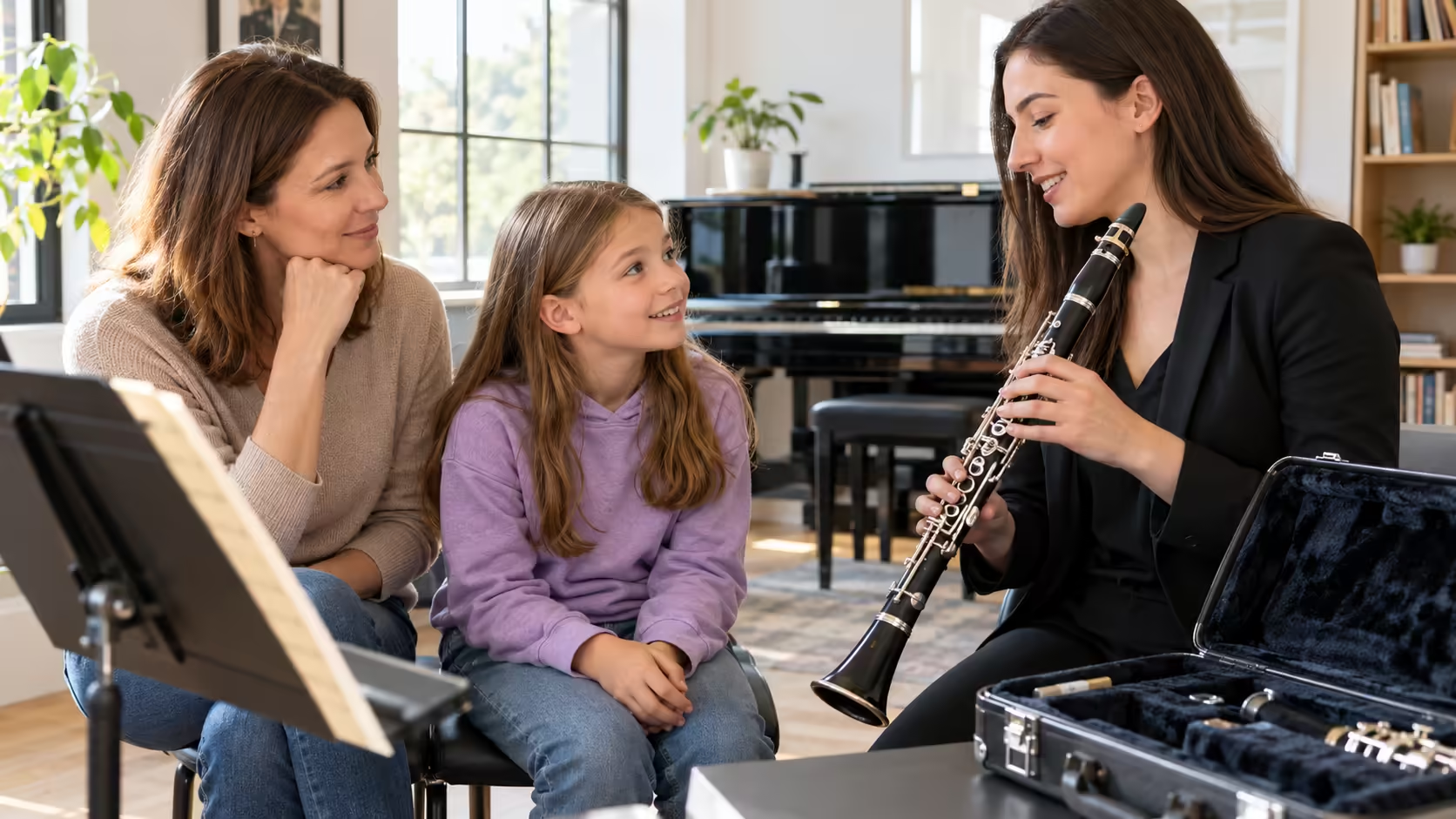
The free trial lesson is also where we walk families through tuition, in plain numbers, with nothing held back.
We're a 501(c)(3) nonprofit conservatory in Mira Mesa — about 15 minutes from La Jolla, UTC, Sorrento Valley, and Carmel Valley. Twelve teachers, 200+ students, and 25 years of doing this in the same neighborhood.
No fee maze. One monthly number.
Most of the hidden costs in this guide simply don't exist at K&M
- Every lesson is private — one student, one teacher, every week
- Flat monthly tuition — the same whether the month holds 4 lessons or 5
- No annual re-registration — the registration fee is one-time, not yearly
- No recital fees — performances in our on-site hall are part of the program
- No accompanist fees — accompaniment is provided, including two grand pianos
- No material surcharges — books and curriculum are built into the program
- A 100% free trial lesson — no credit card, no obligation
Why we talk about tuition on the phone, not on a blog page
You'll notice we haven't printed our rates here. That's deliberate, and it isn't evasiveness.
A single number on a page tells you almost nothing useful. What matters is the lesson length your child actually needs, which teacher fits them, and what the twelve-month total comes to once you've accounted for everything. Those answers are different for a nine-year-old starting from zero and a high school junior preparing college auditions.
So here's our version of the transparency test: come to the free trial lesson, meet the teacher, and we'll give you the full picture in one conversation — monthly tuition, the one-time registration fee, and exactly nothing else. Ask us the twelve-month question. We'll answer it with one number.
What clarinet students get here
- Teachers experienced with beginners — patient through the squeak phase, which is most of month one
- A structured 9-level curriculum — embouchure, air support, and reading introduced in the right order, drawn from the Russian conservatory tradition
- Band-ready preparation — students who start the summer before 4th or 5th grade band arrive already producing a real tone
- Audition coaching — honor band, all-state, and college auditions, including the more challenging clarinet pieces students are asked to prepare
- An on-site recital hall — regular recitals with accompaniment, never an added charge
- Twelve instruments under one roof — clarinet, flute, saxophone, bassoon, piano, violin, cello, guitar, ukulele, harp, voice, and drums, so siblings can study together
- Nonprofit status — tuition funds teaching and the program, not shareholders
Adult beginners are genuinely welcome, too. Adult clarinet players often progress faster than anyone expects, because they practice with intention and know why they're there.
Book a free trial clarinet lesson in Mira Mesa. Meet the teacher, see how your child responds, and we'll walk you through tuition with every fee on the table. No credit card, no obligation.
Book Your Free Trial Lesson5703 Oberlin Dr, Unit 108, San Diego, CA 92121 (Mira Mesa) • 858-588-3938 • Explore all our music lessons
Clarinet Lessons Cost in San Diego: Quick Recap
Here's the whole guide in one breath.
What to budget
- Private lessons: $55–$110 per lesson, or $230–$450 a month for weekly instruction
- Group classes: $20–$50 per class — a different product, not a discount on the same thing
- Supplies and upkeep: another $30–$60 a month for reeds, rental, books, and repairs
- First month: roughly $390–$640, because the one-time purchases land together
- Watch for: annual registration fees, recital fees, accompanist fees, travel fees, five-week-month billing
- Ask everyone: "Including every fee, what's my twelve-month total?"
The three biggest cost drivers are lesson length, teacher experience, and format. Everything else is noise around the edges.
And the smartest move costs nothing. Book two or three free trial lessons before you commit to anyone. Test the fit, ask about the policy in writing, then choose with real information instead of a price list.
Frequently Asked Questions
How much do clarinet lessons cost in San Diego?
Private clarinet lessons in San Diego generally run $55 to $110 per lesson depending on length, which works out to roughly $230 to $450 per month for weekly instruction. Group classes cost less, usually $20 to $50 per class. Plan on another $30 to $60 a month for a rental, reeds, and books.
Why do clarinet lesson prices vary so much in San Diego?
Four factors drive most of the difference: lesson length, the teacher's experience level, the format (private, group, in-home, or online), and the neighborhood. A 30-minute group class with a college student and a 60-minute private lesson with a career clarinetist are different products at different prices.
What hidden costs come with clarinet lessons?
Reeds are the big recurring one at $20 to $35 for a box of ten, replaced every one to two months. Add a clarinet rental at $20 to $40 a month, method books at $15 to $30, annual maintenance at $60 to $200, and at many schools an annual registration fee of $45 to $95. Some programs also charge recital fees, accompanist fees, and travel fees.
Are group clarinet lessons cheaper than private lessons?
Yes, group classes usually run $20 to $50 per class versus $55 to $110 for a private lesson. They are a different product, though. In a group the teacher splits attention across several students, so nobody gets sustained individual correction on embouchure or air support.
Should I rent or buy a beginner clarinet?
Rent first. Rentals run about $20 to $40 a month, usually include maintenance, and many programs apply part of your payments toward a purchase. A used student clarinet costs $150 to $500 and a new intermediate instrument $1,200 to $3,500, so renting keeps your risk low until you know the interest will last.
How many reeds does a beginner clarinet player go through?
A beginner typically uses a box of ten reeds every one to two months, which is about $20 to $35. Reeds are cane and they wear out, chip, and warp. Rotating between three or four reeds instead of playing one until it dies makes each box last noticeably longer.
Are online clarinet lessons cheaper than in-person lessons?
Often somewhat cheaper, because the teacher saves travel time and studio overhead. The savings are real but smaller than people expect, and clarinet is harder to teach on camera than piano or guitar. A teacher needs to see your hand position and hear your tone clearly to fix embouchure problems.
Is clarinet cheaper to learn than violin or cello?
Lesson rates are similar across instruments at most San Diego music schools. The difference shows up in gear. Clarinet has cheap rentals but ongoing reed costs, while violin and cello have no consumables but need bow rehairs and, for growing children, a series of larger sizes.
What happens if I miss a clarinet lesson?
Most studios charge the full lesson fee unless you cancel at least 24 hours ahead. Policies vary widely on makeup lessons, so ask for the cancellation policy in writing before you enroll. A few missed lessons a year can quietly add a few hundred dollars to your total.
What is the cheapest way to learn clarinet in San Diego?
School band is the least expensive path and a genuinely good start. Free trial lessons let you test teachers at no cost, group classes cut the per-student rate, and online practice libraries supplement at $10 to $60 a month. Most families end up combining school band with private lessons.
Can adults learn clarinet from scratch?
Absolutely, and teachers rarely care about age. Adult clarinet players usually book 45 or 60-minute lessons and often progress faster than children because they practice deliberately. Community bands across San Diego welcome adult beginners.
How long does it take to get good at clarinet?
Expect the basics in about three months, a reliably steady tone within a year, and real fluency in three to five years of consistent practice. Daily practice matters more than lesson length. Fifteen focused minutes a day beats one long session on Sunday.