
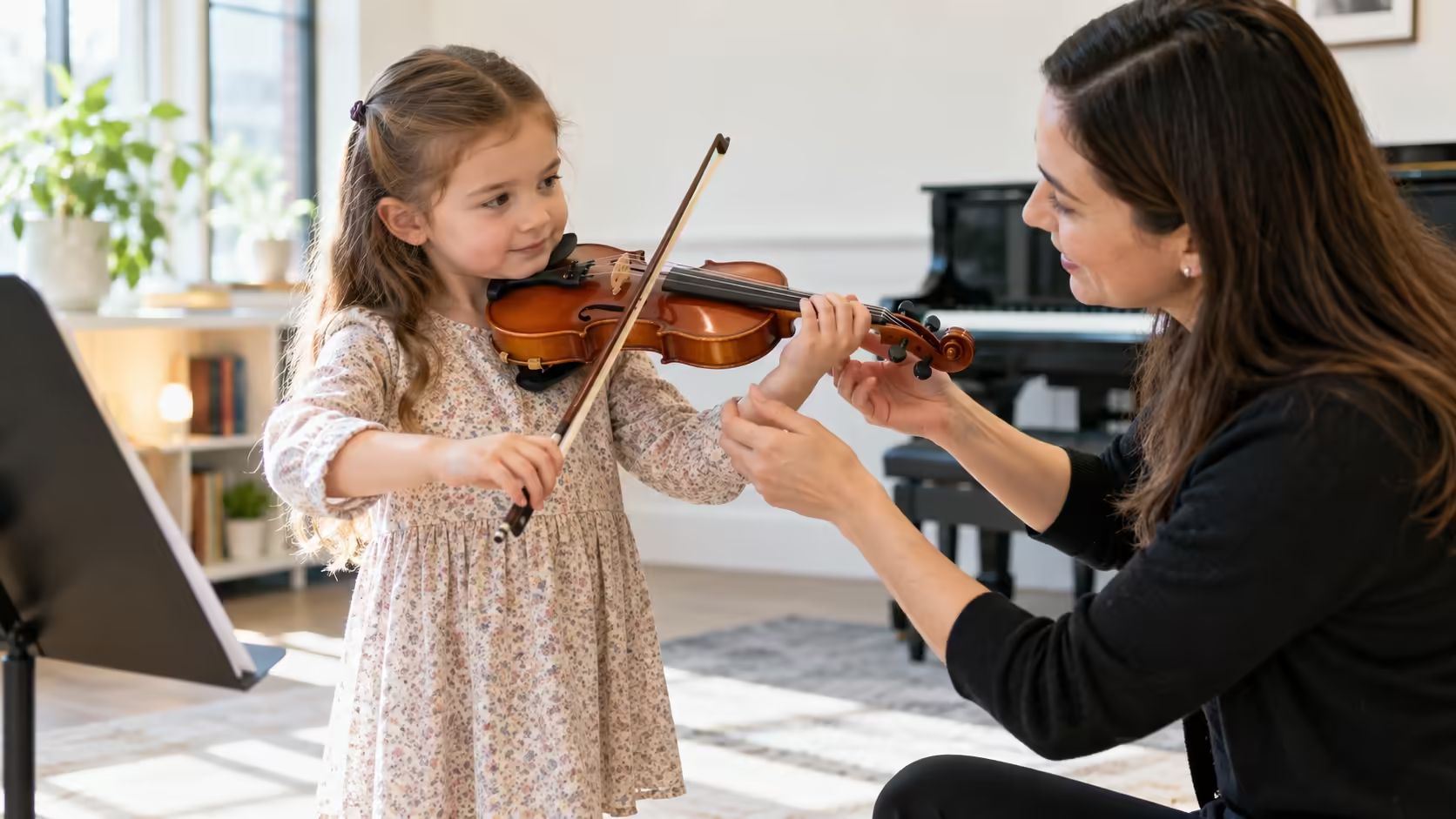

Short answer: The best age to start violin lessons is five to seven for most children. That's when focus, posture, and the ability to follow directions tend to arrive together.
Children as young as three or four can begin in a Suzuki-style program with a parent involved. Ages eight and up are not late — older beginners often move faster because they read fluently and can practice on their own.
The real signal is readiness, not a birthday. A calm four-year-old outperforms a restless seven-year-old every time. Below are eight signs you can check at home this week.

The Best Age to Start Violin Lessons, by Age Group
Your child points at a violinist on screen and says, "I want to do that." You feel a spark of excitement and a small knot of worry at the same time. Is five too young? Is nine already too late?
Here's the honest map. No age on this chart is wrong — each one simply asks for a different kind of teaching.
| Age | What's possible | What to expect |
|---|---|---|
| 3–4 | Suzuki-style lessons with a parent participating | Focus of 5–10 minutes; musical play, not formal study |
| 5–7 | The standard starting window | Real, visible progress within a few months |
| 8–10 | Strong focus and fluent reading | Fast catch-up; often overtakes earlier starters |
| 11–13 | An excellent age to begin seriously | School orchestra within a year or two |
| 14+ and adults | Never too late | Progress tracks practice habits, not age |
Notice what the chart doesn't say. It doesn't name an ideal age, because the exact age matters less than three specific abilities — and those arrive on their own schedule for every individual child.
Why Age Matters — and Why It Isn't the Whole Story
Three things have to be in place before violin lessons work. Age is just a rough proxy for all three.
1. Motor control
The violin is, frankly, an awkward stringed instrument to hold. The left arm reaches across the body, the chin and shoulder grip the instrument, and the right hand balances a bow with a specific curved finger shape. A child needs enough arm length and hand strength to manage that without straining.
2. Attention span
A typical four-year-old focuses for five to ten minutes at a stretch. Most children under eight start to fade around the twenty-minute mark, which is exactly why good teachers keep beginner lessons at 30 minutes or less for ages four to eight.
3. Reading ability
Music notation is easier once a child reads words. That doesn't rule out an early start — Suzuki teaching deliberately delays notation and works by ear first — but it does mean a child who already reads will move through the early material faster.
A patient four-year-old outperforms an impatient seven-year-old. Every violin teacher has watched it happen.
So watch your child, not the calendar. The rest of this guide is about how to read the signals.
8 Signs Your Child Is Ready for Violin Lessons
This is the heart of the matter. Each of these is something you can observe at home over the next week, without spending a dollar.
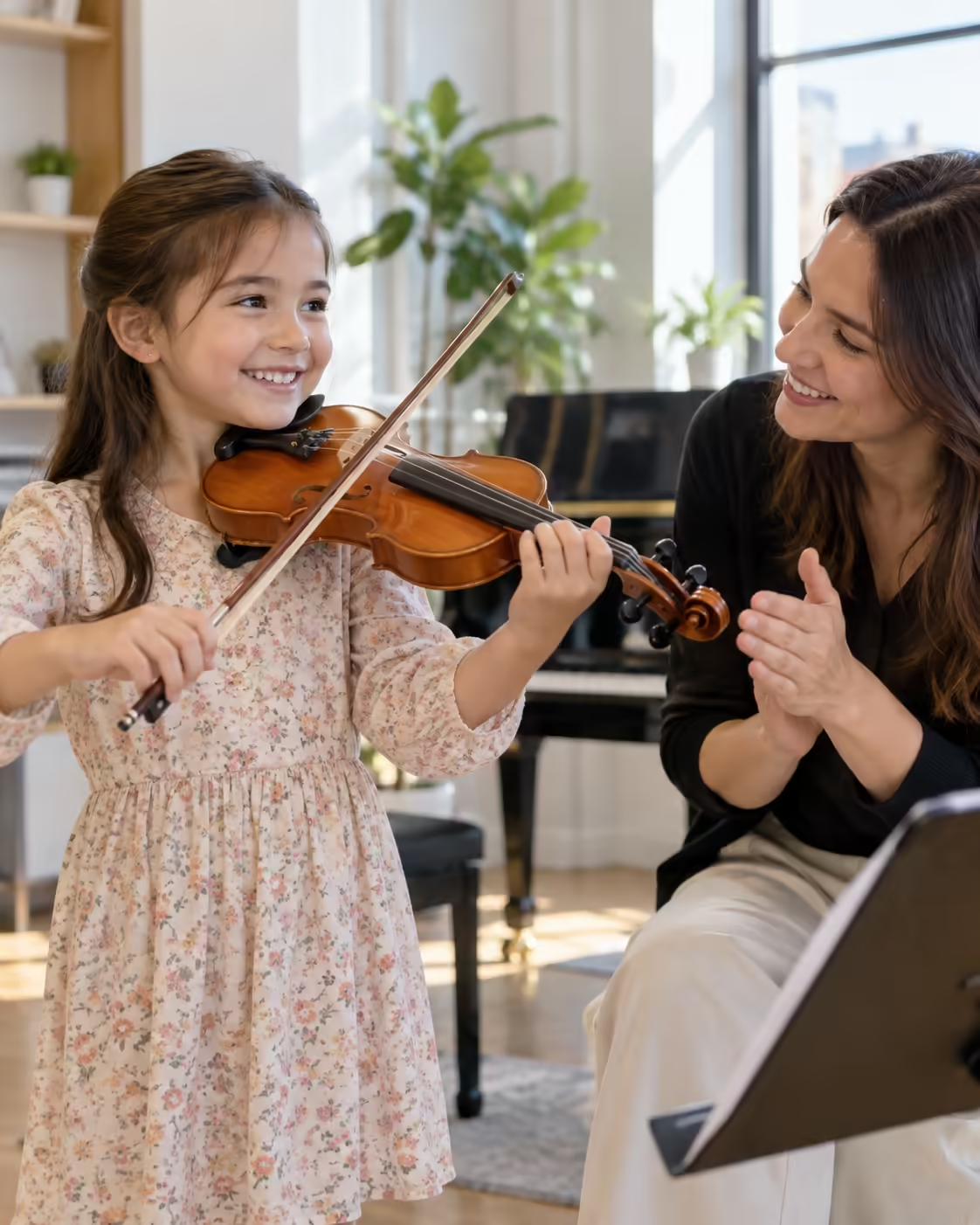
Posture and bow hold come before music. The first weeks are about the body, not the notes.
Your child keeps asking
Repeated interest over several weeks beats a single burst of enthusiasm. A child who is still asking on the third Thursday is a strong candidate. A child who forgot by Tuesday may simply have liked how the instrument looked.
They can hold posture for 10 to 15 minutes
This is the test teachers use most. Can your child stand or sit upright and reasonably still for a quarter of an hour? Violin is played standing, and posture is the foundation of tone.
They accept gentle physical guidance
Violin teaching is hands-on. A teacher will move a shoulder, adjust an elbow, reshape a wrist. A child who is comfortable with that correction learns much faster than one who flinches or pulls away.
They follow two-step instructions
Try it tonight: "Pick up the spoon, then put it in the bowl." A child who completes both steps has the listening skill that early violin instruction depends on. Almost every lesson instruction has two parts.
They sing or move in time to music
Humming roughly in tune and bouncing on the beat are real early skills. Musicality shows up long before technique does, and a child with natural pitch matching has a genuine head start on a string instrument.
They recover from small frustrations
The first months of violin involve constant small failures. A scratchy note, a dropped bow, a squeak. A child who shrugs and tries again will thrive. A child who melts down at every mistake may need a few more months.
They finish short tasks
Does your child complete a puzzle, a coloring page, a simple building project? Finishing small things shows the follow-through that daily practice asks for.
Their arm fits the smallest violin
Fractional violins run in seven sizes from 1/16 upward. If even a tiny violin is too long for your child's arm, wait a few months. Forcing a bad fit produces poor posture and sore shoulders, and those habits are hard to undo.
The readiness scorecard
- Has your child asked about the violin more than twice?
- Can they hold an upright posture for 10–15 minutes?
- Do they accept gentle physical correction?
- Can they follow a two-step instruction?
- Do they sing or clap roughly in time?
- Do they bounce back from small mistakes?
- Do they finish short tasks on their own?
- Does a 1/16 or 1/10 violin fit their arm?
Four or more checks is a green light. Book a trial lesson and watch how your child reacts in the room — that single session will tell you more than another month of reading.
Fewer than four? Nothing is lost. Wait three to six months and run the list again. Children change quickly at this age.
Suzuki vs. Traditional Violin Lessons for Young Children
Two main approaches dominate early childhood music education on the violin. Neither is better — they suit different children and different families.

In Suzuki teaching, the parent is a participant rather than a spectator — at the lesson and at home.
| Feature | Suzuki | Traditional |
|---|---|---|
| Common start age | 3–4 | 5–7 |
| Note reading | Introduced later | Introduced early |
| Parent role | Active participant | Supportive at home |
| Core method | Listening and imitation first | Notation alongside playing |
| Best fit | A very young, eager pre-schooler | A school-age child who already reads |
One practical note. If you have a toddler and are drawn to the Suzuki approach, be aware that the same philosophy exists for other instruments too — Suzuki piano and Suzuki cello follow the same listening-first principles, and piano is often the gentler entry point for a three-year-old.
Many teachers blend both approaches rather than following either strictly. So don't ask which label a studio uses. Ask what a beginner lesson actually looks like, minute by minute.
How to Size a Violin for Your Child
Sizing confuses more parents than anything else on this list, so here is the rule that matters: fit the arm, not the birthday.
Hold the violin in playing position on the child's shoulder. Their left arm should extend along the instrument with the elbow bent at roughly 90 degrees, and their fingers should curl comfortably around the end of the scroll. If the arm is locked straight, the violin is too big.
| Violin size | Typical age range | Approx. arm length |
|---|---|---|
| 1/16 | 3–5 | 14–16 inches |
| 1/10 | 4–6 | about 16.5 inches |
| 1/8 | 5–7 | about 17 inches |
| 1/4 | 6–8 | 18–20 inches |
| 1/2 | 7–9 | 20–22 inches |
| 3/4 | 9–12 | 22–23 inches |
| 4/4 (full) | 12+ | 23 inches and up |
Treat the age column as a rough guide only. Two seven-year-olds can need different sizes, and a teacher will measure properly at the first lesson.
Rent first, buy later
A growing child passes through two or three fractional violins before reaching a full-size instrument. Buying early means buying repeatedly, and an outgrown violin has almost no resale value.
Rentals run roughly $20 to $45 a month, usually include maintenance, and let you swap sizes as your child grows. Buy once the size has stopped changing.
What Violin Lessons Cost in San Diego
Cost shapes the decision for most families, so here are the real ranges for private violin lessons in San Diego.

Lesson tuition is one line item. Strings, rosin, a shoulder rest, and a music stand are the rest of it.
| Lesson length | Per lesson | Per month (weekly) | Best suited to |
|---|---|---|---|
| 30 minutes | $55–$85 | $230–$340 | Beginners, ages 4–9 |
| 45 minutes | $65–$95 | $260–$380 | Ages 9+, teens, adults |
| 60 minutes | $75–$110 | $300–$450 | Advanced players, audition prep |
For a young beginner, 30 minutes is the right length. Longer isn't better when a child's focus runs out at fifteen.
The extras to budget for
Violin has fewer consumables than a woodwind, but the string instruments have their own list:
Month one carries all the one-time purchases. After that, plan on lesson tuition plus roughly $25 to $50 a month for strings, rosin, and upkeep.
Strings break, usually at the worst moment, so keeping a spare set in the case is not optional. A bow rehair runs $50 to $80 and comes due every year or two of steady playing.
One question to ask every school you call
“Including every fee, what will I pay you in total over 12 months for once-a-week 30-minute lessons?”
A school that answers with a single number has a simple fee structure. A school that needs three minutes and a caveat about five-week months has a complicated one — and complicated fee structures are never complicated in your favor.
Watch specifically for annual re-registration fees, recital charges, and accompanist fees. Those are the three that show up later.
How Much Should a Beginner Practice?
Practice should match the child, not an arbitrary target. Too much kills the joy; too little stalls progress.
- Under 6: 10 to 20 minutes a day, often better as two short sessions
- Ages 6–9: 15 to 20 minutes daily, in one sitting if they can manage it
- Ages 10+ and adults: 20 to 30 minutes, building from there
Short and daily beats one long weekend session, and it isn't close. Violin progress is physical — the left hand has to learn where the notes live, and the bow arm has to learn a motion. That kind of learning comes from frequent repetition, not from duration.
Think of it like brushing teeth. Small, daily, non-negotiable, and over before anyone can argue about it.
The opening months are about habits, not music. A clean open-string sound and a correct bow hold are the real goals, even though neither sounds like a song.
You are not auditioning for the next Mozart. You are finding out whether your child enjoys the instrument enough to keep going — and that is a completely different question.
Not Ready Yet? Piano and Cello Are Good Answers
If your child scored below four on the scorecard, waiting doesn't have to mean waiting idly. Another instrument can build the same foundation.
| Instrument | Earliest realistic start | Why it helps before violin |
|---|---|---|
| Piano | 4–5 | A key sounds right the instant you press it, so the child learns notes and rhythm without fighting for pitch. Transfers directly to violin. |
| Cello | 5–6 | Played sitting down, so posture is far easier. The left hand and bow arm work much like the violin's. |
| Violin | 3–4 (Suzuki) / 5–7 (typical) | Hardest start of the three, because the player produces the pitch while holding the instrument in an unnatural position. |
This is worth saying plainly: violin is a hard instrument to begin. That is not a reason to avoid it, but it is a reason to be honest about what the first year asks of a young child.
A year of piano lessons followed by violin at six or seven is a well-trodden path. Plenty of professional violinists began exactly that way, and nothing about the detour is wasted — note reading, rhythm, and the habit of daily practice all carry straight over.
Mistakes Parents Make, and Red Flags in a Teacher
Five common mistakes
- Starting a child who shows no interest — enthusiasm cannot be installed from outside
- Buying an oversized violin to "grow into" — this teaches bad posture that takes years to correct
- Pushing harder because lessons are expensive — pressure and musical curiosity don't coexist
- Switching teachers at the first slow patch — months three through six feel flat for almost everyone
- Comparing a young child to an older sibling — different ages, different brains, different pace
Red flags in a violin teacher or program
- No trial lesson offered
- Lessons longer than 30 minutes for a four- or five-year-old
- No practice plan for home — just "practice more"
- Pressure to buy an instrument on day one instead of renting
- A teacher who won't explain their method in plain language
- Nothing about billing or missed lessons in writing
Questions to ask before you sign up
- What age range do you teach, and do you take adult students?
- How long is a beginner lesson?
- Do parents sit in on lessons?
- What size violin should we rent, and can you measure my child?
- How much daily practice do you expect at this age?
- What's your missed-lesson policy, and is it in writing?
Here is the principle underneath all of it. A good teacher matches the lesson to the child. They never force the child to match the lesson.
Violin Lessons at K&M Music School
You now know what readiness looks like and what to ask. Here's how K&M Music School fits in.
We're a 501(c)(3) nonprofit conservatory in Mira Mesa — roughly 15 minutes from La Jolla, UTC, Sorrento Valley, and Carmel Valley. Twelve teachers, 200+ students, 25 years in the same neighborhood.
No fee maze. One monthly number.
Most of the add-on costs in this guide simply don't exist here
- Every lesson is private — one student, one teacher, every week
- Flat monthly tuition — the same whether the month holds 4 lessons or 5
- No annual re-registration — the registration fee is one-time, not yearly
- No recital fees — performances in our on-site hall are part of the program
- No accompanist fees — accompaniment provided, including two grand pianos
- No material surcharges — books and curriculum are built in
- A 100% free trial lesson — no credit card, no obligation
Why the free trial answers this particular question
Everything in this guide comes down to one thing an article can't judge: is your specific child ready right now?
Arm length, posture, and focus are physical and individual. A violin teacher who works with beginners every week can assess all three in about ten minutes, measure your child for the right fractional size, and tell you honestly whether to start now or wait six months.
That's what the free trial is for. No credit card, and a straight answer either way — including "wait until spring" when that's the right call. We'd rather you start at the right moment than start twice.
What violin students get here
- Teachers experienced with young string players — patient through the scratchy phase, which is most of month one
- A structured 9-level curriculum — posture, bow hold, and reading introduced in the right order, drawn from the Russian conservatory tradition
- Proper sizing at every stage — we measure and re-measure as your child grows through the fractional sizes
- A bridge if they're not ready — we teach piano and cello too, so a year of waiting builds real music literacy instead of losing time
- An on-site recital hall — regular recitals with accompaniment, never an added charge
- Twelve instruments under one roof — violin, cello, harp, piano, guitar, ukulele, flute, clarinet, saxophone, bassoon, voice, and drums, so siblings can study together
- Nonprofit status — tuition funds teaching and the program, not shareholders
Adults are genuinely welcome too. Adult beginners on violin often progress faster than anyone expects, because they practice with intention and know exactly why they're there.
Posture, arm length, focus — a teacher can check all three in one short lesson and tell you honestly whether to start now or wait. K&M offers a 100% free trial violin lesson, no credit card required.
Book Your Free Trial Lesson5703 Oberlin Dr, Unit 108, San Diego, CA 92121 (Mira Mesa) • 858-588-3938 • Explore all our music lessons
Best Age to Start Violin Lessons: Quick Recap
The whole guide in one breath.
The best age to start violin lessons is five to seven for most children. Three and four can work with Suzuki-style teaching and an involved parent. Eight, twelve, or forty-five is not late — older beginners often move faster.
Remember the three anchors. Your child asks for it, more than once. Your child holds posture for 10 to 15 minutes. Your child follows a two-step instruction. Get those three and the rest is teaching.
And keep the risk low. Rent the violin rather than buying it. Book a trial lesson rather than committing to a term. Start with ten focused minutes a day rather than an hour. Then let your child's interest set the pace of the musical journey.
Frequently Asked Questions
What is the best age to start violin lessons?
Most children are ready between ages 5 and 7. By then they can follow two-step directions, hold a steady posture for 10 to 15 minutes, and accept the hands-on corrections violin requires. Some children do well starting at 3 or 4 in a Suzuki-style program with a parent involved, and readiness matters more than the exact age.
Is 4 too young to start violin?
Not always. A focused four-year-old with a patient teacher can absolutely begin, but the lesson has to look like musical play rather than formal study. Expect a focus span of 5 to 10 minutes, short lessons, and a parent who participates at home. A calm four-year-old often does better than a restless seven-year-old.
Is 8 or 10 too late to start violin?
No. Older beginners frequently progress faster than younger ones because they read fluently, understand instructions the first time, and can practice independently. Many students who start at 8 to 10 are playing in a school orchestra within a year or two.
How do I know if my child is ready for violin lessons?
Check three things at home. First, has your child asked more than once over several weeks? Second, can they hold an upright posture for 10 to 15 minutes? Third, can they follow a two-step instruction like "pick up the bow, then rest it on your shoulder"? If all three are yes, book a trial lesson.
What size violin does my child need?
Measure the arm, not the birthday. Violins come in seven fractional sizes from 1/16 up to full size. The fit is right when your child can hold the violin in playing position and curl their fingers around the scroll with the elbow bent at roughly 90 degrees. Most 7-year-olds land on a 1/2 size.
How much do violin lessons for kids cost in San Diego?
Private violin lessons generally run $55 to $110 per lesson depending on length, or roughly $230 to $450 a month for weekly instruction. Budget another $25 to $50 a month for a rental, strings, rosin, and books. Renting is the right call for a beginner, since children outgrow sizes in a year or two.
How long should a beginner practice the violin?
Children under 6 do well with 10 to 20 minutes a day, often split into two short sessions. Beginners of any age can handle 15 to 20 minutes daily. Short and daily beats one long weekend session every time, because the physical habits of violin are built by repetition, not duration.
What is the difference between Suzuki and traditional violin lessons?
Suzuki typically starts earlier, around 3 or 4, teaches by ear before introducing notation, and expects a parent to learn alongside the child. Traditional lessons usually begin at 5 or later and introduce music reading sooner. Many teachers blend both, so ask what a beginner lesson actually looks like.
Should I rent or buy a first violin?
Rent. A growing child moves through two or three fractional sizes before reaching a full-size instrument, so buying early means buying repeatedly. Rentals run about $20 to $45 a month and usually include maintenance. Buy once your child has stopped changing sizes.
Can adults learn the violin?
Yes, and adult beginners often surprise themselves. Progress depends on consistent practice, not age. The real obstacle is practical rather than physical: some studios only teach children, so ask whether a school accepts adult students before you book.
Is violin harder than piano for a young child?
Violin is harder at the very beginning because the player has to produce the pitch themselves while holding the instrument in an unnatural position. A piano key sounds right the moment you press it. Many families start a young child on piano for a year to build note reading and rhythm, then move to violin at 6 or 7.
How long until my child can play a recognizable song?
Most beginners play a simple recognizable tune within three to six months. The first weeks go into posture, bow hold, and a clean open-string sound, which feels slow to parents but is the foundation everything else rests on.


