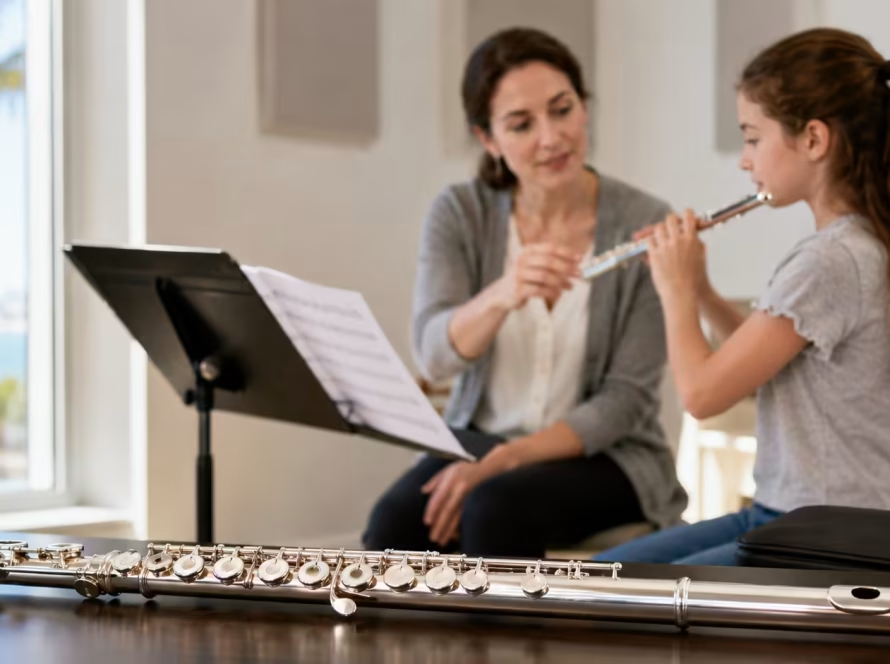
Short answer: Clarinet or flute? The flute is easier to make a first sound on — often on day one. The clarinet is easier to finger and easier to play in tune once the reed and lip shape settle.
Flute wins week one. Clarinet wins year one.
Neither woodwind is genuinely harder than the other. They are hard in different places, at different times — and that's the useful way to choose between them.

Clarinet or Flute: The Short Answer, Side by Side
You're standing in a music shop with your child. Two instruments sit on the counter. The flute gleams. The clarinet waits in its case. And neither of you knows which one to pick.
Here's the honest comparison, in one table.
| What matters | Clarinet | Flute | Easier |
|---|---|---|---|
| First sound | Squeaks for a week or two | Often a real note on day one | Flute |
| Mouth shape | Firm seal; tires the lip at first | No reed, but the air aim is exact | Flute (comfort) |
| Playing in tune | Steady once the embouchure sets | Pitch shifts with every lip change | Clarinet |
| Breathing | Less air, more resistance | Wastes air; runs out fast at first | Clarinet |
| Fingering | Every hole sits under a key | Open-hole models need exact coverage | Clarinet |
| Daily upkeep | Reeds, swab, cork grease | A cleaning rod and a cloth | Flute |
| Starter price | $250–$700 | $200–$600 | Flute, slightly |
Plain verdict: choose the flute if you want a fast win and the lowest upkeep. Choose the clarinet if you want easy fingering and reliable pitch, and you don't mind one extra daily habit.
Now here's why each of those rows comes out the way it does.
The First-Sound Test
Speed to a first sound is the clearest way to compare these two woodwind instruments. It's also what matters most to a nervous beginner who is quietly afraid of being bad at this.
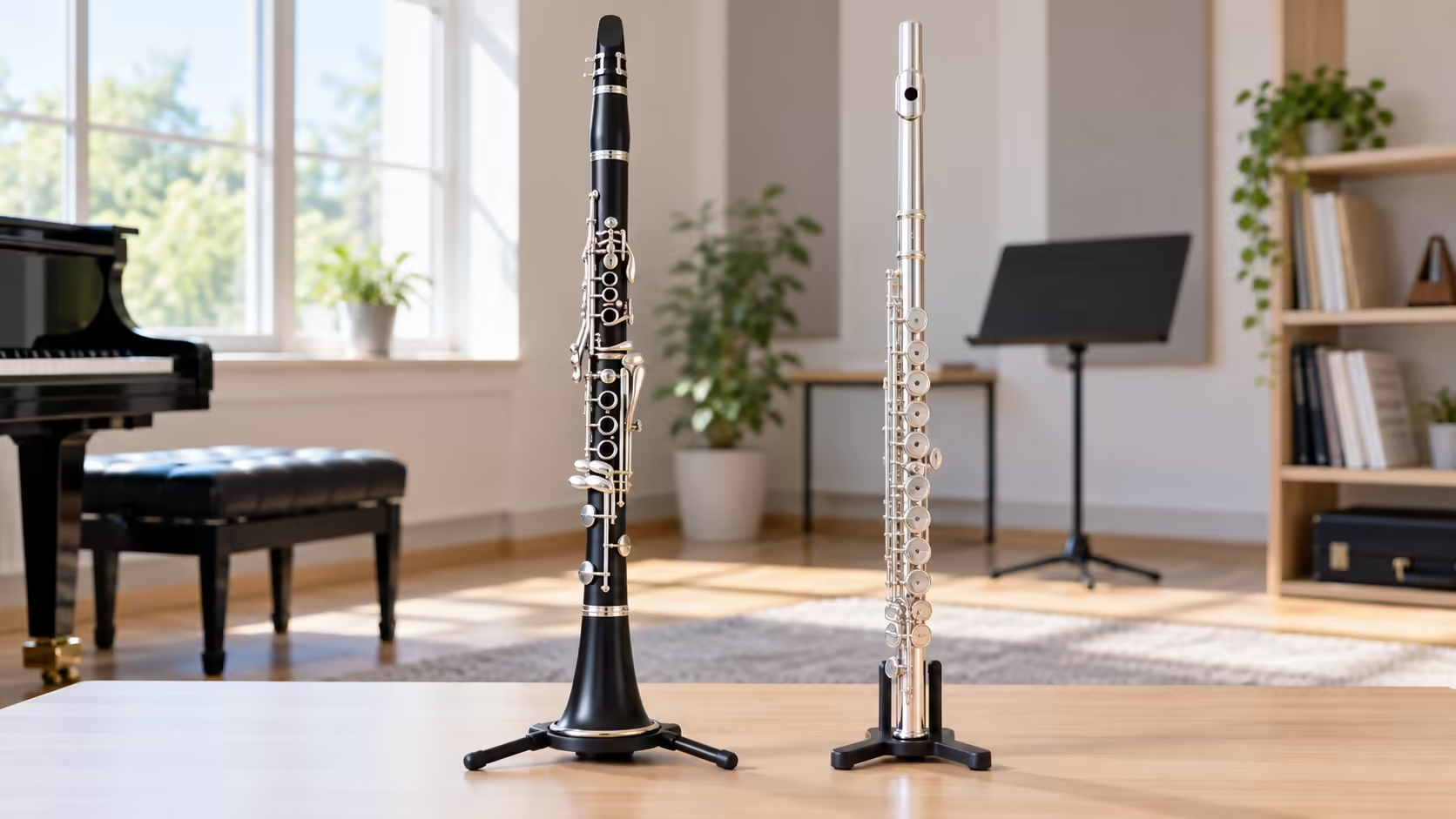
The reed is the whole difference. One instrument has a daily consumable; the other does not.
How fast does a flute beginner make a sound?
Most flute students produce a clear, airy tone in the first lesson. It's genuinely satisfying, and it's a real confidence win on day one.
A reliable, musical tone still takes two to three months of steady practice. Fifteen to twenty minutes a day is the right dose at this stage.
How fast does a clarinet beginner make a sound?
Squeaks and squawks are normal in week one. Every clarinet player has lived through them, including every professional.
The clarinet adds one extra step before any sound happens at all. You wet the reed, seat it against the mouthpiece, tighten the ligature, and shape your lips around it. That setup makes the learning curve start flat. Most beginners reach a steady tone within two to three weeks on a soft reed.
Why the reed changes everything
A reed is a variable you cannot ignore. A chipped reed plays badly. A dried-out reed barely plays at all. Clarinet players think about reeds every single day; flute players never think about them once.
That sounds like a pure disadvantage, but it isn't. The flip side is that a reed is something you can change to fix a bad sound. When a clarinet student's tone goes rough, swapping the reed often solves it in thirty seconds. When a flute student's tone goes rough, the only fix is practice.
Start soft. Strength 2 is the standard first reed, and 1.5 is even easier to blow for a young beginner with developing lip muscles.
Harder reeds (3 and up) give a bigger, more focused tone but demand far more air pressure. Moving up too early is one of the most common reasons a beginner's sound gets worse instead of better.
Embouchure: Which Mouth Shape Is Harder to Learn?
Embouchure is just the way your lips, teeth, and jaw shape the air. On any woodwind, it's the whole game.
The flute embouchure
Air crosses an open hole rather than passing over a reed. Your lips form a small, relaxed opening, and the air stream has to strike the far edge of the tone hole at the right angle. Small changes in that angle jump the sound an octave or kill it entirely.
Nothing presses into your lip, which makes it physically comfortable from the start. But that precision of aim is genuinely difficult, and advanced players spend years refining it. The classic beginner problem is a weak, breathy sound that wobbles in and out.
The clarinet embouchure
Your lower lip cushions your bottom teeth, your top teeth rest directly on the mouthpiece, and the corners of your mouth hold a firm seal. It takes real muscle work, and beginners often feel pressure on the lower lip for the first few weeks while those muscles strengthen.
Once they adapt, though, that firm seal is exactly what makes clarinet pitch so stable.
| Embouchure factor | Winner | Why |
|---|---|---|
| Physical comfort | Flute | No reed pressing into the lower lip |
| Pitch stability | Clarinet | The firm seal holds the note steady |
| Small lips, weak muscles | Flute | Needs less sustained muscle tension |
| Consistency week to week | Clarinet | Less sensitive to tiny lip changes |
Breath and Air: Which Instrument Asks for More?
Air is the fuel for both, but they burn it very differently.
The flute: high air demand
The flute wastes air by design. Most of your breath passes over the tone hole rather than into the instrument. Players learn to support the stream from the belly and release it steadily — and breathing that way is a skill, not a reflex.
Running out of air is the number-one complaint from new flute players. It improves, but only with time.
The clarinet: more resistance, less waste
The reed pushes back, so very little air escapes. A smaller, more concentrated air stream does the job. Some beginners find that steady pressure tiring before the lip and abdominal muscles adjust, but the sheer volume of air required is lower.
One-line verdict: flute players run a long race. Clarinet players hold a steady squeeze.
For a child with asthma or low lung capacity, this distinction is worth raising with a teacher directly. Neither instrument is off limits, but the clarinet's lower air demand is often the gentler starting point.
Fingering: Which Is Kinder to Small Hands?
This is where the clarinet clearly wins, and it matters more than most parents expect.
The clarinet finger chart
Every tone hole is covered by a key or a ring. Your fingers press mechanisms, not bare holes, so coverage is forgiving — a finger that lands slightly off center still seals. The low register, called the chalumeau, responds especially well to beginners.
There is one famous hurdle: the break, the awkward transition between registers. It's a real obstacle, but it arrives in month three or four, not week one.
The flute finger chart
Open-hole flutes (also called French models) have bare holes in the center of some keys, and your fingers must cover them exactly. For small hands, that's genuinely hard.
Closed-hole flutes remove the problem entirely, and they are the correct first choice for any young beginner. The high register remains demanding regardless, because it needs strong air and a tight, focused lip.
If you choose the flute, insist on a closed-hole model
Some shops will offer an open-hole flute because it's what advanced players use, or because it's what's in stock. For a first year, that's the wrong instrument.
A closed-hole flute eliminates an entire category of frustration before it starts. Many models also come with plugs so the same instrument converts later.
Ask for a curved headjoint too if your child is small. It shortens the reach significantly and makes the flute playable for a seven-year-old who couldn't otherwise manage it.
What to Actually Buy First
Choosing the instrument is step one. Choosing a specific instrument is where families waste the most money.
Which clarinet does a beginner play?
The B♭ soprano clarinet. That's the standard, and it's what "clarinet" means in a school band. The rest of the family comes later: the bass clarinet is a common second instrument in high school, the E♭ clarinet is a specialist's instrument, and the contralto clarinet is rare enough that most players never touch one.
So when you shop for a first clarinet, you're shopping for exactly one thing. That simplifies the decision considerably.
Plastic or wooden?
Plastic, without hesitation. Reliable plastic clarinets are the standard for beginners for good reasons: they cost less, they survive being dropped, and above all they don't crack when temperature and humidity swing.
Wooden clarinets sound warmer and are what professionals play, but a wooden instrument needs careful acclimatization and can crack outright if neglected. That's a poor match for a ten-year-old's backpack. Most students move to a wooden clarinet somewhere around year three or four, if at all.
New, used, or rented?
- Rent first. $20 to $40 a month, usually with maintenance included, and many shops apply part of your payments toward a purchase.
- Second-hand is excellent value once you know the interest will last — but buy a used clarinet from a shop that has serviced it, not from a marketplace listing. A $200 instrument needing $250 of pad work is not a bargain.
- Avoid ultra-cheap clarinets. The $80 instruments sold online are often genuinely unplayable: leaking pads, misaligned keys, mouthpieces that no reed will seal against. A child who struggles on one of those concludes they have no talent, when the real problem is the hardware.
The same logic applies to flutes. Established makers — Yamaha among them — build student models specifically to be forgiving, and a quality instrument from a known maker holds its value far better than a no-name one.
For method books, the standard series are widely used across school programs, and Abracadabra Clarinet is a common choice for private tutoring. Your teacher will specify — don't buy books in advance.
Clarinet vs. Flute: Cost Comparison
Here's the part that surprises most families: lesson rates are identical for both instruments. At essentially every music school, you're paying for a teacher's time, and a clarinet lesson and a flute lesson cost exactly the same.
So the entire cost difference between these two instruments is gear.
| Expense | Clarinet | Flute |
|---|---|---|
| Student instrument | $250–$700 | $200–$600 |
| Monthly rental | $20–$40 | $20–$40 |
| Recurring supplies | Reeds, $20–$35 per box of 10 | Essentially none |
| Starter accessories | Swab, cork grease, ligature, stand | Cleaning rod, cloth, stand |
| Annual service | $60–$200 (pads, springs) | $70–$220 (more keys and rods) |
Month one carries the one-time purchases. After that, flute runs about $5 a month in supplies; clarinet runs $15 to $30 because of reeds.
Short term the flute is cheaper, purely because there are no reeds. Long term the two converge, since both need periodic pad and key work — and the flute's greater number of keys and rods actually makes its repairs slightly more expensive.
Private music lessons in San Diego generally run $55 to $110 per lesson depending on length. That figure doesn't change based on which of these two you pick.
Best Age to Start: Clarinet or Flute?
Age shifts the answer, and so does hand size.
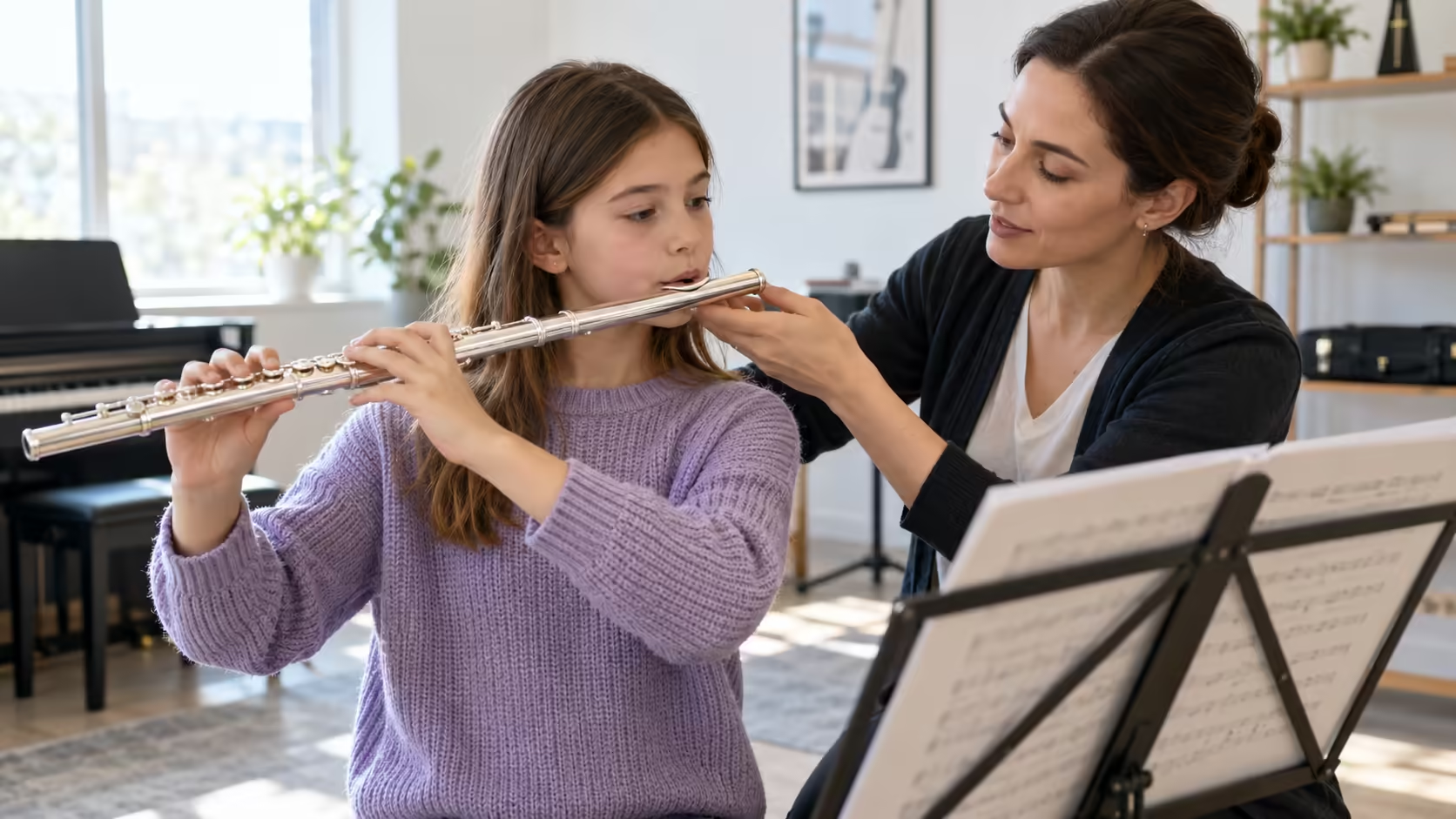
A curved headjoint shortens the reach, which is what makes flute workable for a smaller child.
Flute: around 7 and up
The flute is light, easy to hold, and makes no demand on the front teeth. Some teachers accept students a little younger when a curved headjoint is available to shorten the reach.
Clarinet: around 8 to 10
The clarinet mouthpiece rests against the upper front teeth, so teachers strongly prefer students to have their adult front teeth — usually in place around age 8. It also asks for more lip strength and breath support than a six-year-old can supply. Most school band programs start clarinet in 4th or 5th grade, which lands students at 9 or 10.
| Child's situation | Better fit |
|---|---|
| Small, eager, age 7 | Flute (with curved headjoint) |
| Still waiting on adult front teeth | Flute |
| Small hands, age 8–9 | Clarinet (keys forgive imprecise fingers) |
| Low lung capacity or asthma | Clarinet (less air volume needed) |
| Short attention span | Flute (no reed routine to maintain) |
| Plans to add saxophone later | Clarinet (fingerings transfer) |
How Long Each One Takes to Learn
Honest timelines, assuming 15 to 20 minutes of daily practice.
| Milestone | Clarinet | Flute |
|---|---|---|
| First recognizable note | 1–3 weeks | Often day one |
| Reliable, musical tone | 2–3 months | 2–3 months |
| Simple songs | 3–6 months | 3–6 months |
| Comfortable in band rehearsals | 1–2 years | 1–2 years |
Look closely at that table. After the first month, the timelines are the same. The flute's advantage is real but it's front-loaded — it buys early confidence, not faster progress.
Clarinet players frequently catch up and pass flute players on tuning and articulation during year one, because the mechanical fingering and stable embouchure let them focus on musical coordination instead of fighting for the note.
School Band Realities
School band adds a layer that private lessons don't, and it's worth factoring in before you spend anything.
Band directors need a balanced ensemble. Too many flutes and not enough low voices produces a thin, top-heavy sound, so directors sometimes steer students toward what the program actually needs.
- Flute seats can be competitive. Flute is one of the most popular instruments among beginners, especially girls, so the section often fills fast.
- Clarinet sections are larger, which usually means more open seats and a better chance of getting the instrument your child asked for.
The practical move: email the band director before you buy or rent anything. Ask what the program is short on next year. A student who fills a needed seat gets more playing time, better parts, and a faster path to the top of the section.
Both instruments read the same band music and appear in every concert band, so either choice keeps your options open. Beyond school, flute has a substantial place in orchestras and classical music, while the clarinet spans classical, klezmer, and jazz — a number of the great jazz musicians of the swing era were clarinetists.
Can You Switch Later?
Yes, and plenty of players do. Reading skills, breathing habits, and musical training carry over in every direction — none of the first year is wasted if you change your mind.
But the switches are not equally easy, and the brief version you'll hear repeated online is usually wrong:
| Switch | Difficulty | Why |
|---|---|---|
| Clarinet → saxophone | Easy | Both are single reed instruments; fingerings overlap heavily |
| Clarinet → bass clarinet | Easy | Same fingering system, bigger instrument |
| Flute → clarinet | Moderate | A reed embouchure has to be built from nothing |
| Clarinet → flute | Moderate | The reed goes away entirely; air aim is a new skill |
| Either → brass instruments | Harder | A completely different technique: buzzing lips, not reeds or air streams |
The headline: clarinet to saxophone is the genuinely easy jump, not clarinet to flute. If your child has their eye on saxophone down the road, starting on clarinet is a strategic choice rather than a detour.
Doubling — playing two instruments well — also makes a player far more useful to a band and, later, more employable. Most professional woodwind players double.
The Decision Guide
Six statements. Pick the ones that sound like your family.
Choose flute if you want a fast first win
A note on day one is a powerful motivator for a child who is nervous about being bad at something new.
Choose clarinet if small hands are the worry
Keys and rings forgive imprecise fingers in a way bare tone holes never will.
Choose flute for a child under 8
No reed, no front-teeth requirement, and a curved headjoint handles the reach.
Choose clarinet if daily routine isn't a problem
Reed care is a small habit, but it is a habit. A child who manages it gets the pitch stability as a reward.
Choose flute if you dislike high-maintenance gear
A cleaning rod and a cloth, and you're done. There is nothing to buy again.
Choose clarinet if saxophone is the real goal
The fingerings transfer directly. Two years of clarinet makes the saxophone switch almost trivial.
Stop deciding. Start testing.
Everything above is useful, but it's still theory. Here's the test that actually settles it:
Book a trial lesson on each instrument. Practice fifteen minutes a day on both for a week. Then watch which case your child opens without being told to.
That's your answer. The instrument a child practices is the easier one — for that child. No comparison table beats a week of actual evidence.
Clarinet and Flute Lessons at K&M Music School
Here's the thing about this particular decision: you shouldn't have to make it alone, and you shouldn't have to make it permanently.
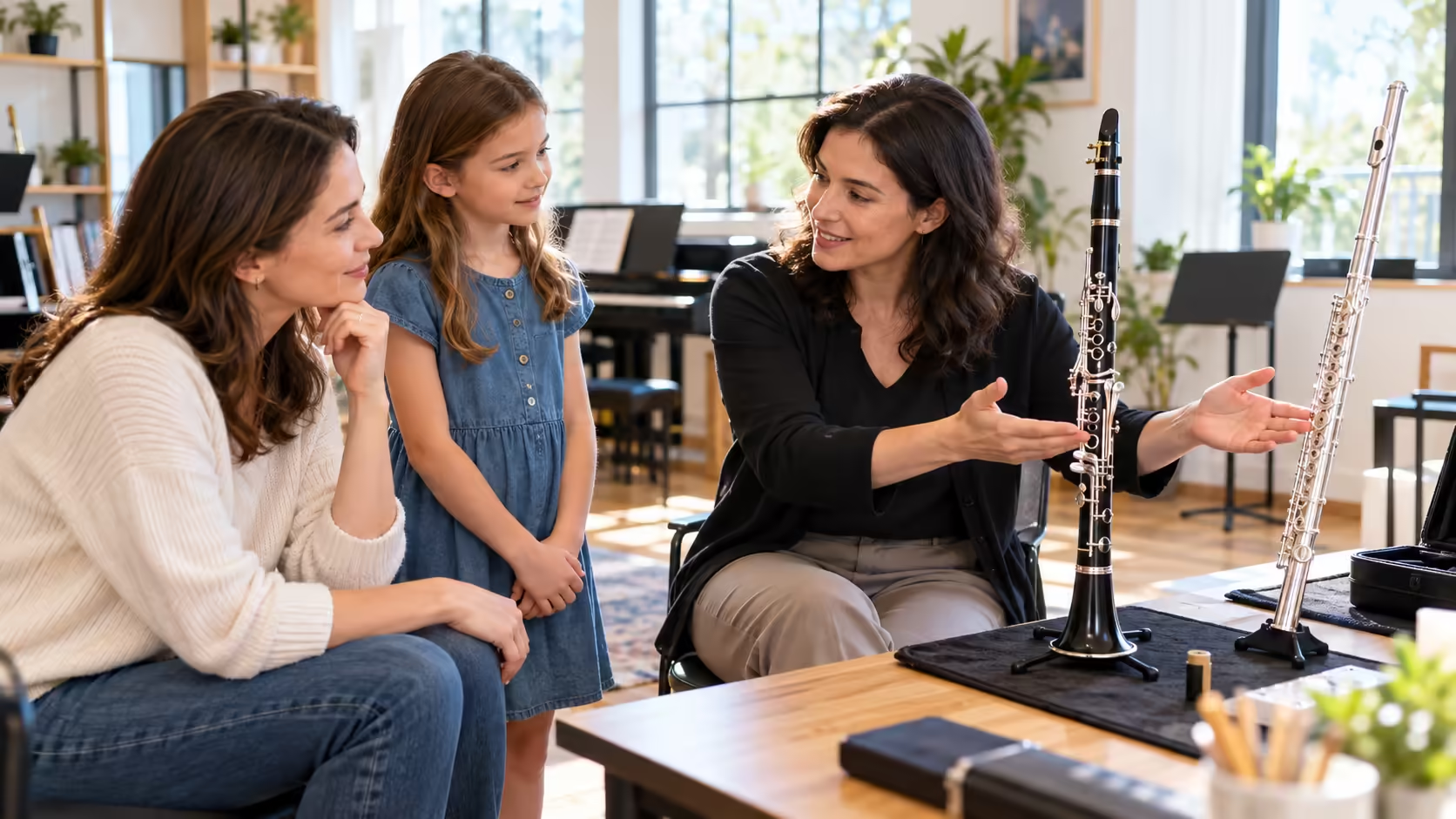
Ten minutes with a teacher and both instruments in hand answers more than any article can.
K&M Music School is a 501(c)(3) nonprofit conservatory in Mira Mesa — about 15 minutes from La Jolla, UTC, Sorrento Valley, and Carmel Valley. We teach both of these instruments, which means we have no stake in which one you pick.
Try both. Then decide.
We teach the whole woodwind family, so changing your mind doesn't mean changing schools
- A free trial lesson on each — clarinet and flute, no credit card, no obligation
- An honest recommendation — teeth, hand size, and breath checked by someone who teaches beginners weekly
- Switch without starting over — we also teach saxophone and bassoon, so year two can go a different direction
- Every lesson is private — one student, one teacher, every week
- Flat monthly tuition — the same whether the month holds 4 lessons or 5
- No recital fees, no accompanist fees, no annual re-registration
What a clarinet trial lesson actually tells you
Three things an article can't: whether your child's adult front teeth are in and stable, whether their hands reach comfortably, and whether they can sustain the air pressure a reed requires. A teacher assesses all three in about ten minutes.
The flute trial answers a different question — whether your child can find the air angle at all, and whether the reach works with the headjoint we have.
Do both in the same week and the decision usually makes itself.
What woodwind students get here
- Teachers experienced with beginners — patient through the squeak phase, which is most of month one on clarinet
- A structured 9-level curriculum — embouchure, air support, and reading introduced in the right order, drawn from the Russian conservatory tradition
- Band-ready preparation — students who start the summer before 4th or 5th grade band arrive able to play
- Guidance on what to rent — closed-hole flute, reed strength, which plastic clarinets are reliable, and what to avoid
- An on-site recital hall — regular recitals with accompaniment, never an added charge
- Twelve instruments under one roof — clarinet, flute, saxophone, bassoon, piano, violin, cello, guitar, ukulele, harp, voice, and drums
- Nonprofit status — tuition funds teaching and the program, not shareholders
Adults are welcome too. Adult beginners on both instruments often progress faster than anyone expects, because they practice with intention and know exactly why they're there.
Book a free trial lesson on clarinet and one on flute. Meet the teachers, let your child hold both, and get an honest recommendation from someone who teaches beginners every week. No credit card, no obligation.
Book Your Free Trial Lesson5703 Oberlin Dr, Unit 108, San Diego, CA 92121 (Mira Mesa) • 858-588-3938 • Explore all our music lessons
Clarinet or Flute: Quick Recap
The whole guide in one breath.
What to remember
- Flute wins week one — a real note on day one, and no reeds to buy, ever
- Clarinet wins year one — easier fingering, steadier pitch, less air required
- After month one the timelines match — the flute's edge is confidence, not speed
- Lesson rates are identical — the only real cost difference is gear
- Rent, don't buy — and never buy an $80 instrument from an online marketplace
- Closed-hole flute, strength 2 reed — the two specs that prevent the most frustration
- Clarinet to saxophone is the easy switch — not clarinet to flute
- Ask the band director — open seats matter more than difficulty
Neither instrument is wrong. The flute is easier to start; the clarinet is easier to keep playing well. Both are great instruments, and both will teach your child to read music, control their breathing, and play with other people.
So rent both for a week, or book a trial lesson on each. Play fifteen minutes a day. Then let your child choose the one they can't put down — because that's the one they'll practice, and practice is the only thing that actually decides how far this musical journey goes.
Frequently Asked Questions
Clarinet or flute: which is easier for a beginner?
The flute is easier to get a first sound out of, often on day one. The clarinet is easier to finger and easier to play in tune once the reed and embouchure settle. Flute wins week one; clarinet wins year one. Neither instrument is harder overall — they are hard in different places at different times.
Which instrument makes a sound faster?
The flute. Most beginners produce an airy but recognizable note in the first lesson. The clarinet adds a step: wetting the reed, seating it, tightening the ligature, and forming a tighter lip seal. Expect squeaks for the first week or two on clarinet.
Is the clarinet easier to finger than the flute?
Yes, for most beginners. Every clarinet tone hole sits under a key or ring, so coverage is forgiving. Open-hole flutes require exact finger placement over bare holes, which is difficult for small hands. A closed-hole flute removes that problem entirely and is the right first choice for a young beginner.
Which instrument needs more air?
The flute. Much of the air escapes past the tone hole instead of entering the instrument, so flute players run out of breath quickly at first. The clarinet offers resistance from the reed, so less air is wasted — but holding that steady pressure tires the lip muscles until they adapt.
How much does a beginner clarinet or flute cost?
Student clarinets run about $250 to $700 and student flutes about $200 to $600. Renting is usually smarter at $20 to $40 a month, and most shops apply part of your payments toward a purchase. Avoid instruments under about $150 — they are often genuinely unplayable and will convince a child they have no talent.
Which costs less to own long term?
The flute, mainly because there are no reeds. Clarinet players spend $20 to $35 on a box of ten reeds every one to two months. Flute players need little more than a cleaning rod and a cloth. Over several years the two converge, since both need periodic pad and key work.
What is the best age to start clarinet or flute?
Flute can start a little earlier, around 7, because it is light and a curved headjoint shortens the reach for small arms. Clarinet usually starts at 8 to 10, since it needs adult front teeth to anchor the mouthpiece plus enough breath support. For a small, eager seven-year-old, flute typically fits better.
Do clarinet reeds make it harder to learn?
At the start, yes. Reeds chip, warp, and dry out, and a bad reed makes a good player sound terrible. Beginners should start on a soft reed — strength 1.5 or 2 — which blows more easily and produces a better early tone. The upside is that a reed is also something you can swap to fix a bad sound.
Which instrument is better for school band?
Ask the band director before buying anything. Flute seats are often competitive because so many students request them, while clarinet sections are larger and tend to have more openings. Both read the same band music, and most programs allow a switch after the first year.
Can you switch from clarinet to flute later?
Yes, though it is a real change — the flute has no reed, so the embouchure is built from scratch. The genuinely easy switch is clarinet to saxophone: both are single-reed instruments with overlapping fingerings. Many players double, and reading skills and breath habits carry over in every direction.
Which is louder, the clarinet or the flute?
The clarinet is warmer and more contained across its range. The flute carries further in its high register, which is why flute lines sit on top of a band texture. In a living room, neither is unreasonably loud compared with brass instruments or drums.
Should I rent or buy a first clarinet or flute?
Rent. Rentals run $20 to $40 a month, usually include maintenance, and let you return the instrument if your child changes their mind. Buy once you know the interest will last — a second-hand instrument from a reputable shop is then excellent value.