
Short answer: Private violin lessons in San Diego run $55–$110 per lesson depending on length — roughly $230–$450 per month for weekly instruction. Add $20–$50 a month to rent the violin.
Group string classes are a cheaper, separate option at $20–$40 per class. Most beginners start with 30-minute private lessons — young kids can't focus longer, and you can always upgrade later.
Plan on roughly $295–$485 for the first month once you add rental and starter gear. After that, it settles lower.

What Private Violin Lessons Cost in San Diego
Most schools bill monthly rather than per session. That changes how you should compare them — always convert to the same unit before deciding.
Private lessons — the real numbers
| Private Lesson Length | Per Lesson | Per Month (Weekly) |
|---|---|---|
| 30 minutes | $55–$85 | $230–$340 |
| 45 minutes | $65–$95 | $260–$380 |
| 60 minutes | $75–$110 | $300–$450 |
In-home lessons typically add $10–$25 per lesson for the teacher's travel.
Group string classes — a different product
Group classes run $20–$40 per class. That's real savings, and for a young child testing interest it can be a sensible first step. But violin is a posture-and-precision instrument — bow hold, left-hand frame, intonation. In a room of eight children, those details rarely get individual correction. Group is a good way to discover violin; private is how children actually learn it.
Which Lesson Length Fits Your Child

For young beginners, attention is the real limit — not the budget. Start short.
A simple rule of thumb:
| Length | Best For |
|---|---|
| 30 minutes | Ages 4–8, or any true beginner |
| 45 minutes | Ages 9–12, or kids past their first year |
| 60 minutes | Serious teens, audition prep, youth orchestra players, adult learners |
Start short. Attention is the real limit, not your budget. A focused 30 minutes beats a restless 45 every time for a six-year-old.
Adult beginners
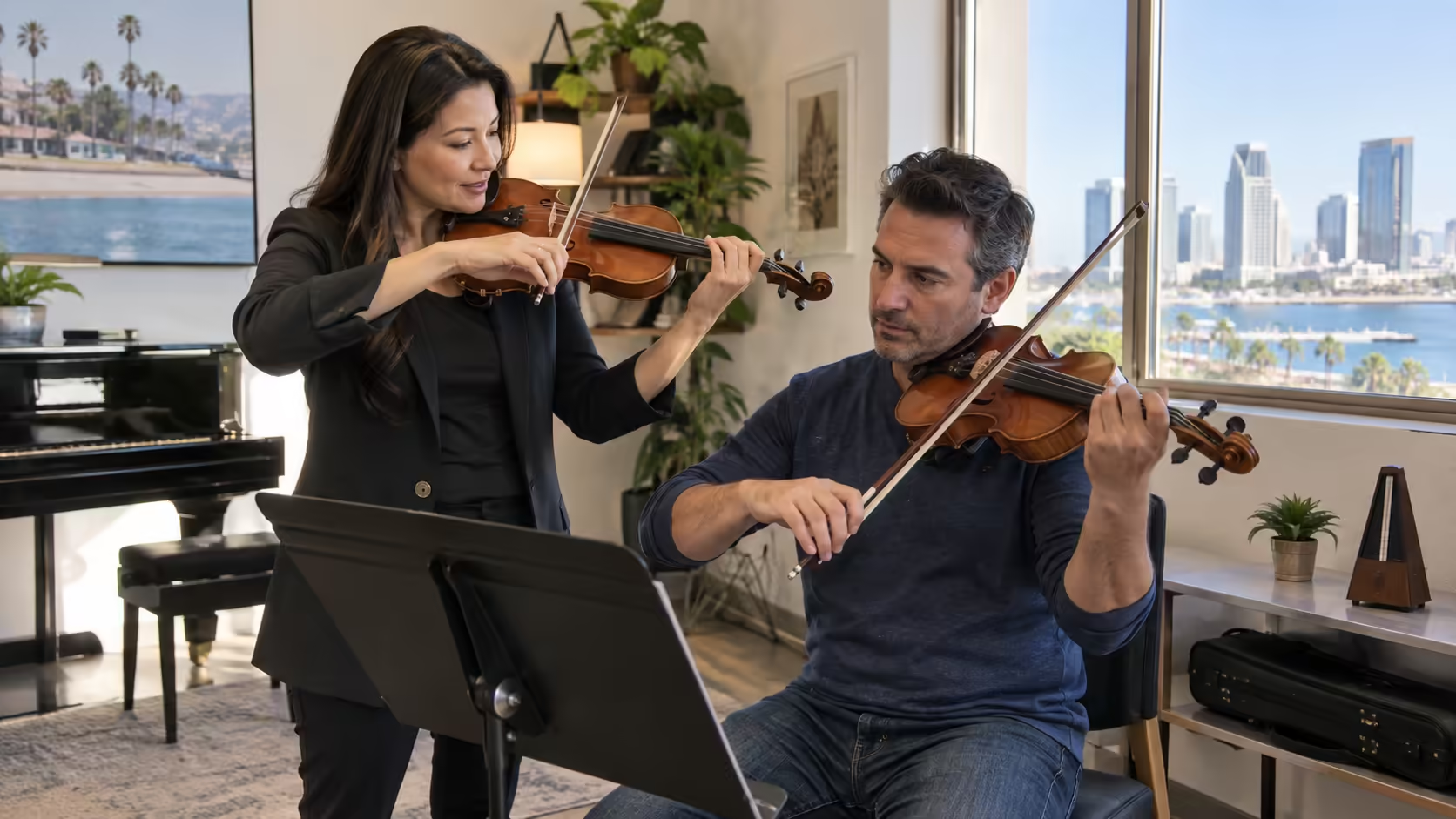
Adults can absolutely start violin — and usually prefer 45 or 60 minutes to cover posture, bow work, and a piece.
Adults starting violin usually do best with 45 or 60 minutes. Violin's early learning curve is physical — holding the instrument, building a relaxed bow arm, finding notes without frets — and adults generally want enough time to work through those pieces properly rather than rushing. The pricing is the same as for children; the pacing and repertoire are different.
Who Teaches Matters More Than Where
Here's something rate cards won't tell you: the teacher's background moves the price more than the address. The same half hour can cost very different amounts depending on who's teaching and what surrounds the lesson.

The first lesson tells you more than any rate card: watch how the teacher handles a stuck moment.
| Teacher Type | Typical Per Hour | What You Get |
|---|---|---|
| Structured music school | $80–$110 | A curriculum, recitals, substitutes, a set calendar, accountability |
| Suzuki-trained teacher | $70–$95 | Ear-first method built for very young beginners, heavy parent involvement |
| Independent private teacher | $55–$85 | Scheduling flexibility; quality varies widely |
| College-student teacher | $35–$55 | Lower cost; often talented, but less teaching experience and less continuity |
| In-home lessons | Base rate + $10–$25 | No commute; convenience premium |
Structured music schools
You pay a bit more, and you get more around the edges: a curriculum that sequences skills in the right order, a front desk that handles scheduling, a substitute when your teacher is sick, and a stage to perform on. For violin specifically, the curriculum matters — skipping steps in bow technique or left-hand position creates problems that surface a year later.
Independent teachers
They set their own rates, and a great independent can be excellent value. The trade-off is that you handle everything yourself: scheduling, makeups, what happens when they move or stop teaching. Get the cancellation and makeup rules in writing.
Suzuki-trained teachers
The Suzuki method is designed for small children — learning by ear first, heavy parent involvement, starting as young as 3 or 4. The extra training carries a premium, and the method asks a lot of parents' time.
College-student teachers
Often very capable players at a lower rate. The honest caveat: playing well and teaching well are different skills, and students graduate and leave — which can mean switching teachers mid-progress.
At the first lesson, ask: "How do you help a student who gets stuck?"
A good answer is specific — breaking a passage down, changing the exercise, slowing the bow. A vague answer ("they just need to practice more") tells you more than the rate card ever will.
Group Classes and Budget Options
One-on-one isn't the only way in, and it's worth knowing the full landscape.
Group string classes
Group formats cut the bill and add something a private room can't: friends. For a young child who isn't sure violin is for them, a group class is a low-risk way to find out. Expect $20–$40 per class.
Free and low-cost community programs
San Diego does have nonprofit and community programs offering free or low-cost group string classes, sometimes with loaner instruments, typically for school-age children. They're genuinely valuable for families who need them.
One honest note: these programs usually have waitlists, and spots fill early in the school year. Apply as soon as registration opens, and keep a paid option in mind as a backup.
Summer intensives
Week-long summer string programs are another way to test serious interest before committing to a full school year of weekly lessons.
Start with a group class or a trial lesson. If your child practices without being asked and keeps talking about it, move to private lessons — that's where the real technical progress happens. You'll spend less upfront and know the interest is real before committing.
The True Cost: Rentals, Gear & Add-Ons
The monthly lesson rate is only part of the bill. Here's the rest, so nothing catches you off guard.
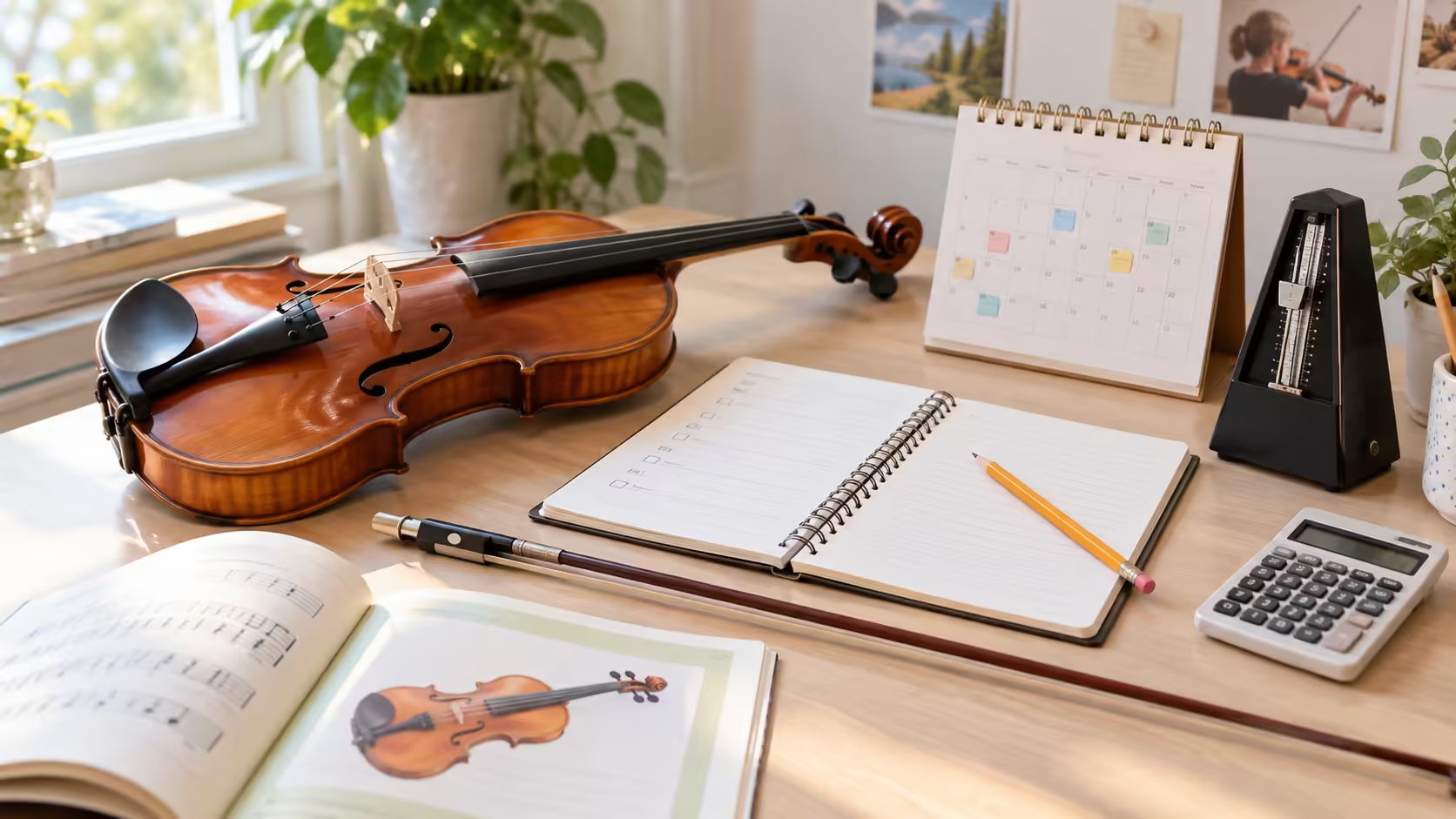
Lessons, rental, and starter gear — plan all three together and the first month holds no surprises.
Rent first, always
Children's violins come in fractional sizes: 1/16, 1/10, 1/8, 1/4, 1/2, 3/4, and full-size 4/4. Kids outgrow them the way they outgrow shoes — sometimes every year. That's why renting wins. Expect $20–$50 a month.
Ask whether the rental plan includes:
- Damage protection — small children drop things
- Free size exchanges as your child grows
- Rent-to-own credit — part of each payment applied toward purchase
Starter gear (one-time)
- Shoulder rest — $15–$30
- Rosin — $5–$15
- Music stand — $15–$25
- Method book — $10–$25
Total starter gear: about $45–$95.
What schools often charge separately
- Registration or membership: $0–$60 per year, often recurring annually
- Recital fees: $0–$50 per event
- Accompanist fees: violin recital pieces usually need a pianist — some schools charge extra for this
- Books and materials: $10–$25 per level
- Late payment: $10–$25
- Missed sessions: you may still owe — read the makeup policy
- 5-week-month upcharges if you're billed per lesson
None of these is large alone. Together they can add $150–$400 to a year.
The transparency test
Ask each school: "Including every fee — registration, recital, accompanist, books, anything else — what will I pay you in total over 12 months for weekly 30-minute private violin lessons?"
A clear single number means a transparent school. A long list of "it depends" is worth noting.
Your First-Month Budget
Here's what month one realistically looks like for a child starting weekly 30-minute private lessons:
After month one, expect about $250–$390/month (lessons + rental), plus any registration or recital fees your school charges.
Violin vs. Piano vs. Cello Costs
Parents often weigh two or three instruments at once. The useful fact: most schools charge by lesson length, not by instrument. Violin, piano, and cello lessons usually share one rate card.

Violin and piano pair naturally — and many families end up with a child learning both.
The real difference is the equipment:
| Violin | Cello | Piano | |
|---|---|---|---|
| Lesson rate | Usually identical at the same school | ||
| Instrument (start) | Rent $20–$50/mo | Rent $30–$70/mo | Digital $400–$2,000, or acoustic |
| Ongoing upkeep | Strings, rosin, size changes | Strings, rosin, size changes | Acoustic: tuning $100–$200, 1–2×/yr |
| Portability | Very easy | Needs a larger car | Stays home |
| Online lessons | Harder — posture and bow angle need in-person correction | Harder, same reasons | Works reasonably well — camera sees both hands |
Violin is generally the cheapest instrument to start. A fractional violin rents for less than a family pizza night each month. Cello sits in the middle — higher rental, bigger case. Piano has the highest upfront cost but no size changes.
Nothing stops a child from adding piano later. Many families who start with violin eventually add piano for music theory and reading — and at a school that teaches both, siblings or a single child can often schedule back-to-back.
What Each Budget Level Actually Buys

A recital date on the calendar changes how a child practices. It turns "practice" into "preparing."
Under $200 a month
Group classes, community programs, or a short weekly slot with a newer teacher. Kids learn a bow hold, basic scales, and first songs. Plenty of lifelong players started here, and it's a perfectly reasonable way to find out whether violin sticks.
$230–$340 a month
Weekly 30-minute private lessons with an experienced teacher at an established school. Expect a real curriculum, clear weekly goals, recitals, and faster correction of the habits that trip up violinists later — a collapsed wrist, a tense bow arm, flat fourth fingers.
$340–$450 a month
45 to 60 minutes with an experienced teacher. This is for older children past their first year, teens preparing for auditions or youth orchestra seating, and adult learners who want depth.
The honest truth about price and progress
Here's the part every parent eventually learns: practice drives progress more than price does. A child who practices five days a week will outpace a child who practices twice, regardless of what either family pays.
But that's exactly why structure matters. What you're actually paying for at a good school isn't a better half hour — it's the environment that produces five-day-a-week practice. A written weekly assignment. A teacher who notices when practice slips. A recital date on the calendar that turns "practice" into "preparing." A clear next level to reach.
Those things are what keep a nine-year-old picking up the violin on a Tuesday. Spend on the setup that keeps your child practicing — that's where the value is.
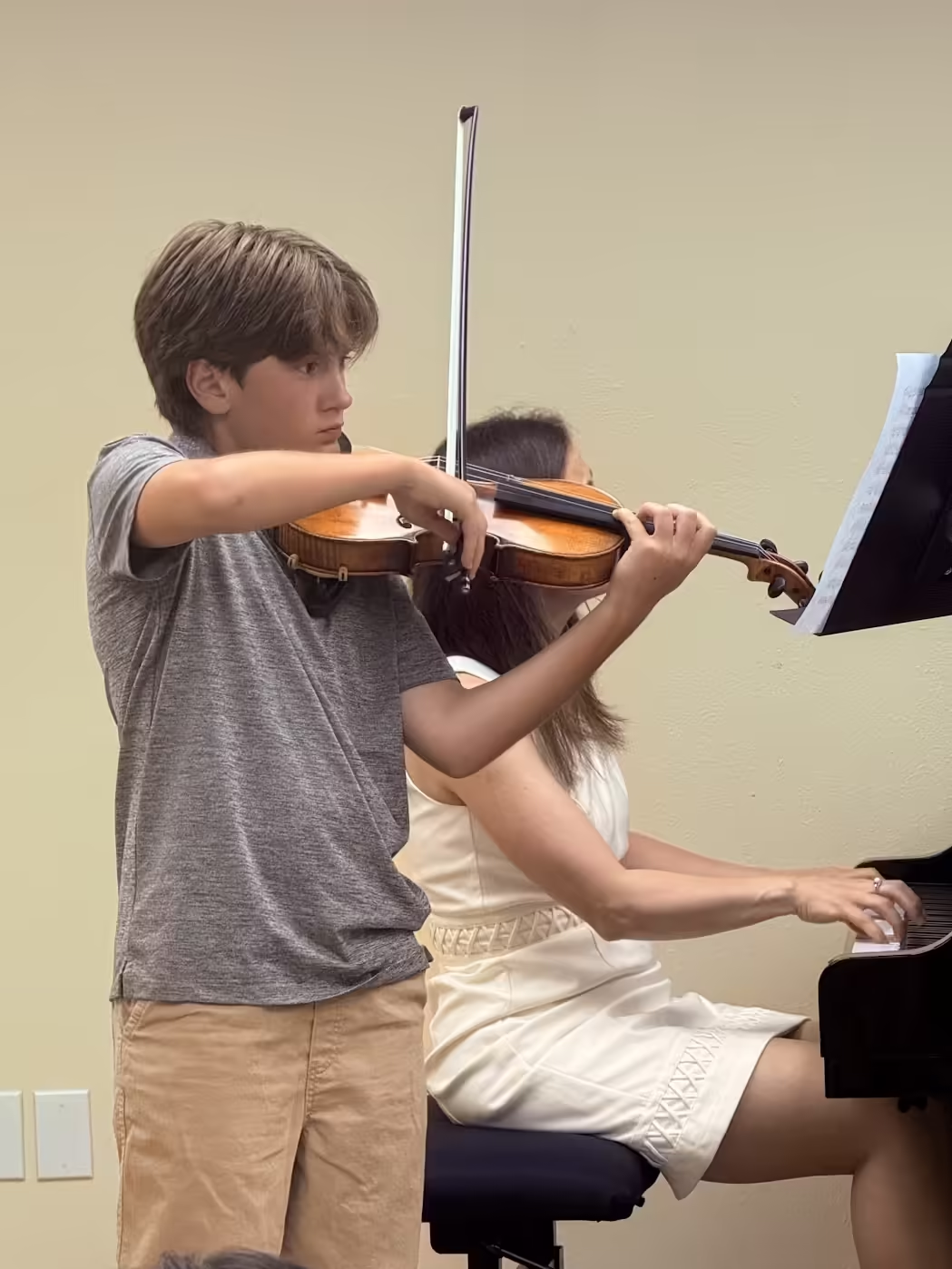
Years of steady weekly lessons, adding up. This is what consistency looks like.
5 Ways to Pay Less Without Getting Less
Book 30 minutes for young beginners
A six-year-old gets full value from a focused half hour. Upgrade to 45 minutes around age 9, when focus and repertoire both grow.
Rent for at least the first year
A $300 violin purchase locks you into the wrong size within months. Rental with size exchanges is almost always cheaper for growing children.
Choose flat monthly billing
Per-lesson billing costs 25% more in five-week months. A flat monthly rate evens it out and makes budgeting simple.
Ask about sibling scheduling
Two children at one school means one drive instead of two. Back-to-back lessons save real time and gas every week.
Compare total annual cost, not the lesson rate
A $60 lesson with annual fees, recital fees, and accompanist charges can cost more per year than an $80 lesson with nothing added on.
Violin Lessons at K&M Music School
If you've read this far, you know what violin lessons in San Diego really cost — the private rates, the rental, the add-ons, and what each level buys. Here's how K&M Music School fits into that picture.
Violin Lessons at K&M
Weekly one-on-one violin lessons — flat monthly rate, no surprise charges
- Every lesson is private — one student, one teacher
- Same flat monthly rate whether the month has 4 lessons or 5
- One-time $50 registration fee — not annual
- 100% free trial lesson — no credit card required
- No recital fees, no accompanist charges, no 5-week-month upcharges
Where K&M sits in the market
Compare our rates to the private lesson table at the top of this guide: $70 / $80 / $90 per lesson sits in the middle of the San Diego private violin market at every lesson length — and within the typical range for a structured music school.
What violin students get at K&M
- A structured curriculum — the 9-level Russian conservatory program, with a strong string tradition. Bow technique and left-hand position built in the right order, so problems don't surface a year later.
- An on-site recital hall with piano accompaniment — your child performs with a real pianist on a real stage, and it's never an extra charge
- Help with violin sizing and rental — especially important as children move through fractional sizes
- Violin, cello, and piano under one roof — plus eight more instruments, so siblings and future second instruments are easy to schedule
- Written weekly assignments and clear level milestones — the structure that keeps kids practicing
- 501(c)(3) nonprofit status — mission-driven, not investor-driven
We're about 15 minutes from most of North San Diego, including La Jolla, UTC, Sorrento Valley, and Carmel Valley.
The fastest way to know if violin is right for your child is a real lesson with a real teacher. K&M offers a 100% free trial violin lesson — we'll help with sizing too, so you can rent the right instrument from day one.
Book Your Free Trial Lesson5703 Oberlin Dr, Unit 108, San Diego, CA 92121 (Mira Mesa) • 858-588-3938 • Learn more about violin lessons
Frequently Asked Questions
How much do private violin lessons cost in San Diego?
Private violin lessons in San Diego typically cost $55 to $110 per lesson depending on length and teacher experience — roughly $230 to $450 per month for weekly instruction. A 30-minute lesson sits at the lower end, a full hour at the upper end. Group string classes are a separate, cheaper option at $20 to $40 per class.
How much does it cost to rent a violin in San Diego?
Violin rentals typically run $20 to $50 per month depending on size and plan. Most rental programs include damage protection and apply part of your payments toward eventual purchase. Renting is strongly recommended for children, who outgrow fractional sizes quickly.
What is the first-month cost of violin lessons?
Plan for roughly $295 to $485 in the first month: lesson tuition ($230 to $340 for weekly 30-minute private lessons), rental ($20 to $50), and one-time starter gear like a shoulder rest, rosin, music stand, and method book ($45 to $95). After that, monthly costs settle at about $250 to $390.
What age should a child start violin lessons?
Ages 4 to 7 is a classic starting window, because fractional-size violins fit small hands. Many children start between 5 and 8. Older beginners catch up quickly — motivation and consistent practice matter more than the starting age.
Are 30-minute or 60-minute violin lessons better for kids?
Thirty minutes fits most children under 9 — attention span is the real limit, not budget. Children 9 to 12 usually move to 45 minutes. Teens preparing for auditions or youth orchestra benefit from a full hour.
Should I buy or rent a violin?
Rent first. Children move through fractional sizes (1/16, 1/10, 1/8, 1/4, 1/2, 3/4) as they grow, and a purchased violin will be the wrong size within months. Buy only once your child reaches full size, usually in the early teen years.
Are there free or low-cost violin programs in San Diego?
Yes. Some nonprofits and community programs offer free or low-cost group string classes and loaner instruments, typically for school-age children. Spots are limited and waitlists are common, so apply as soon as registration opens and keep a backup plan.
Is violin more expensive than piano lessons?
The lesson itself usually costs the same — most schools charge by lesson length, not instrument. The difference is equipment: a violin rents for $20 to $50 a month, while a piano costs hundreds to thousands to buy and needs regular tuning. Violin is generally the cheaper instrument to start.