
Short answer: Stage fright in children is normal, and student recitals are one of the best ways to work through it. Each performance teaches a child that the nervous feeling rises, peaks, and passes.
Recitals do not make nerves disappear. They make nerves familiar. A child who has performed before usually dreads the next performance less, even if their heart still beats fast.
Your job as a parent is small and specific: make the preparation predictable, say very little on the day, and be kind afterward.

What Student Recitals Teach, at a Glance
A recital is a few minutes on stage. What a child takes from it lasts much longer.
| What recitals teach | Why it helps | What parents notice |
|---|---|---|
| Performing for an audience | The stage becomes a familiar place | Less dread before the next recital |
| Managing nerves | The child learns the feeling passes | Calmer mornings on performance day |
| Working toward a date | A deadline gives practice a purpose | Better focus in the weeks before |
| Sharing the stage | Builds social confidence | Pride, and interest in other students' pieces |
| Playing through a mistake | Shows that a slip does not end the piece | Less fear of getting things wrong |
Quick answers
| Question | Answer |
|---|---|
| Do recitals reduce stage fright? | Yes, over time. Experience makes the nerves familiar. |
| Is stage fright normal? | Yes. It is one of the most common feelings in young musicians. |
| What should I say before a recital? | One short, calm, encouraging sentence. |
| What if my child makes mistakes? | Comfort first. Praise the effort, not the result. |
| Should a nervous child skip recitals? | Skipping one is fine. Skipping all of them makes the fear grow. |
Nerves become manageable. They do not vanish.
Experience changes how a child feels in the days before a performance. It does not switch off the body's alarm on the day.
So never tell a child the nerves will go away. Tell them the nerves get easier to carry. That promise is one you can keep.
What Is Stage Fright in Children?
The body reacts before the mind does
A racing heart. Shaky hands. A dry mouth. A blank feeling where the first note used to be. These are ordinary stress responses, and they show up in young musicians all the time.
Performance anxiety can appear in very young children, and many professional musicians still feel it. A four-year-old can have it. So can a forty-year-old.
Nerves are a skill gap, not a personality flaw
Parents often say “my child is just shy.” That makes the fear sound permanent, and permanent things make children give up.
It helps to see performance nerves as a missing skill. Nobody has taught the child what to do with the feeling yet. A skill can be practiced, just like a scale.
How common is it?
Very. Depending on the study, roughly one in five to one in two young music students report performance anxiety, and it tends to rise in the teenage years.
The range is wide because children differ. If your child struggles more than most, that is still within normal.
Why Recitals Help More Than Avoiding Them
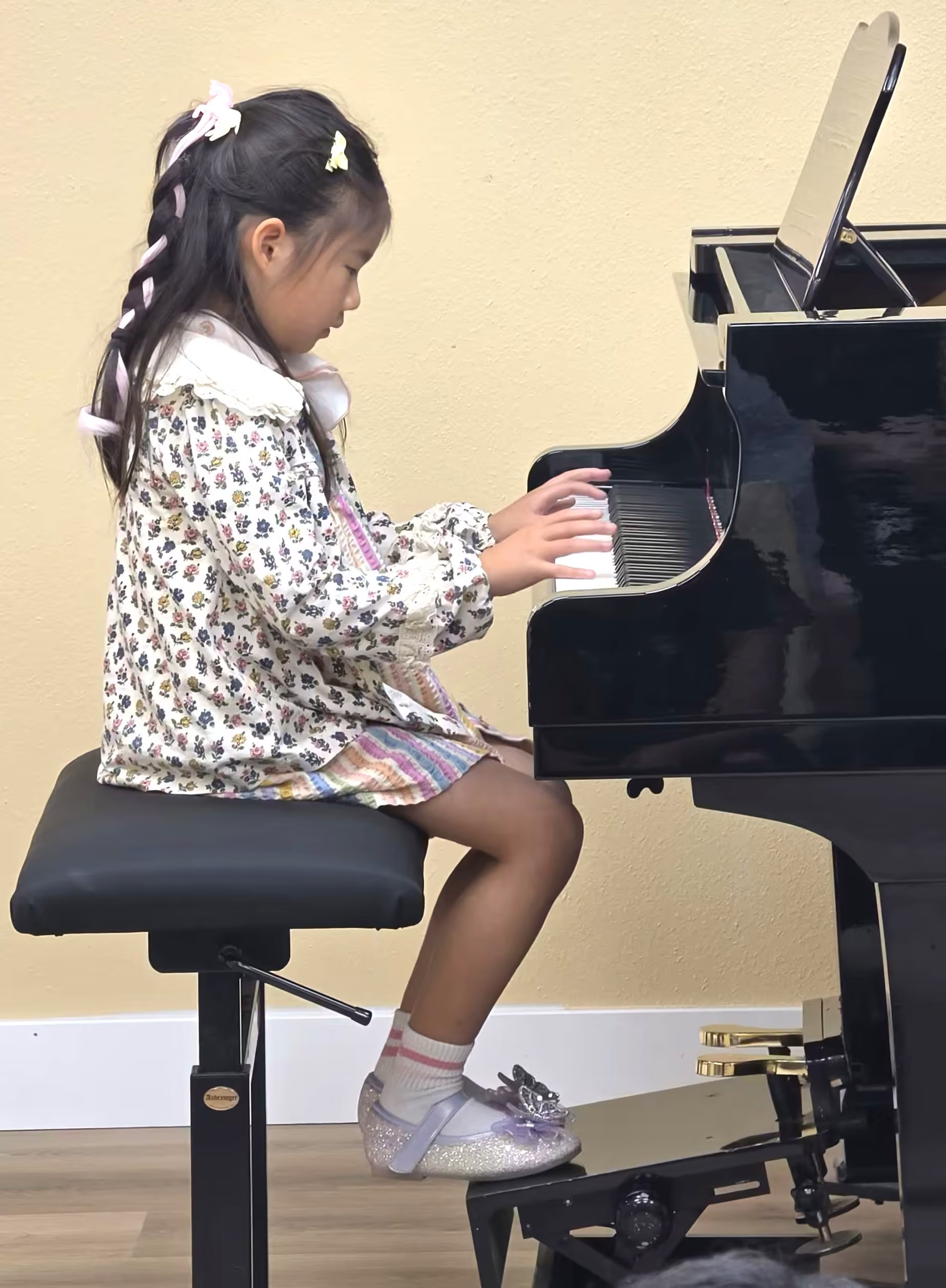
The first recital is the hardest. The second one starts with proof that it can be done.
Experience changes the waiting
The worst part of stage fright is often the week before, not the minutes on stage. Children who have performed before tend to worry less in that waiting period. They know how the story ends.
Practice performances work the same way. Each run-through in front of someone counts as experience.
Why some children feel it more
Children who expect perfection from themselves usually have stronger stage fright. They worry about mistakes even when they are well prepared.
For these children, more practice alone does not solve it. They need to hear, often, that a wrong note is part of performing and not the end of it.
What avoiding teaches
Skipping every recital feels kind in the moment. But a child who never performs never learns that the feeling passes. The fear stays the same size, or grows.
A supportive recital teaches the opposite: mistakes are normal, the audience is friendly, and nervous feelings fade once the music starts.
Start Small: The Audience Ladder
Do not go from the living room straight to the recital hall. Build up the audience one step at a time.
| Step | Audience |
|---|---|
| 1 | Two family members at home |
| 2 | A grandparent on a video call |
| 3 | One friend |
| 4 | A small group, such as visiting relatives or a few classmates |
| 5 | A student recital |
Each step should feel slightly uncomfortable and completely doable. Stay on a step until it feels boring, then move up.
Ask about low-pressure options
Many music schools have something smaller than a formal recital: an informal performance, a play-through for another student, or a rehearsal in the hall. Ask the teacher what exists. It is often not advertised.
Duets and playing with an accompanist
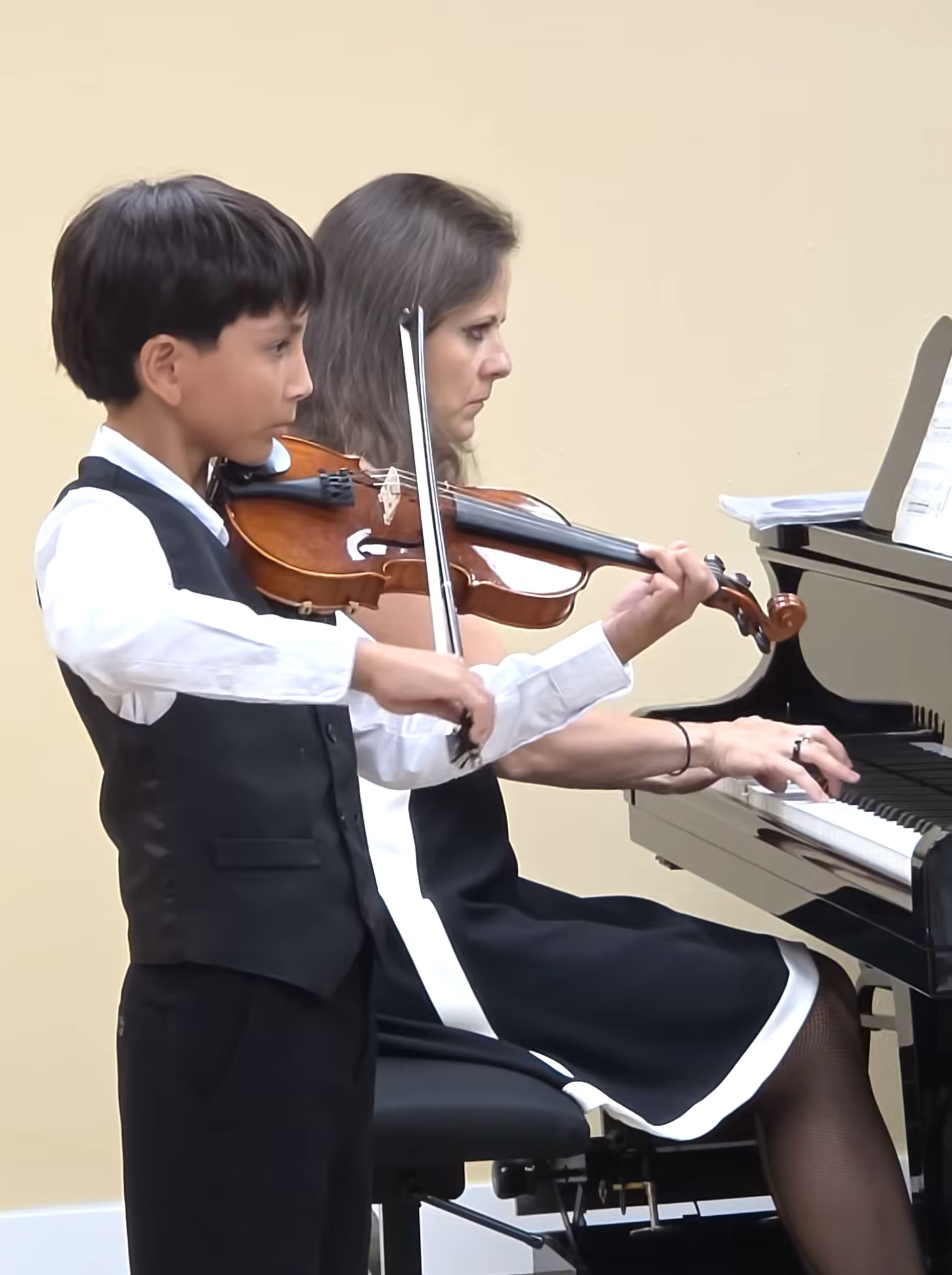
Sharing the stage with an accompanist or a teacher takes away the lonely feeling.
Playing with a teacher, a partner, or an accompanist changes the stage. The child is no longer alone up there. If they lose their place, the music keeps going and they can join back in.
It also gives the child a job beyond “don't mess up.” Listening to a partner is something to do. A job is easier to hold than a hope.
The Parent's Role in Recital Confidence
Say less than you want to
A short “I'm proud you're doing this” beats a five-minute speech. Children read adult nerves very accurately, and a long talk signals danger.
Keep your own anxiety out of the room
Children pick up a parent's tension fast. Sit a few rows back. Smile once. Put the phone down.
Praise the process, not the result
Three phrases that work: “You kept going after the slip.” “You looked at the audience.” “You practiced every day this month.”
Each one names something the child controls and can repeat next time.
Let your child see you be imperfect
Play or sing something badly in front of them. Laugh at your mistake. Then keep going. That teaches more about recovery than any talk about resilience.
Name the feeling instead of denying it
Do not say “don't be nervous.” Say “nervous means this matters to you.” Then give the body something to do, such as slow breathing.
The Four Weeks Before a First Recital
Uncertainty drives most recital nerves. A simple plan removes it.
| When | What to do | Who |
|---|---|---|
| 4 weeks before | Confirm the date, arrival time, place, dress code, performance order, and whether sheet music is allowed on stage | Parent |
| 3 weeks before | Play the whole piece once a day without stopping, mistakes included | Student and teacher |
| 2 weeks before | Perform for one person at home. Practice the bow. | Parent |
| 1 week before | Play in the recital room if possible, or on a different piano in a different room | Teacher |
| 2 days before | Normal sleep, normal meals, no changes to the music | Parent |
| Recital day | Arrive early, warm up with one scale, find the restroom and the stage entrance, take a few slow breaths | Parent |
That first row matters more than families expect. A child who knows where to sit, when they play, and what to wear has fewer things to imagine going wrong.
How to practice a recital piece
Slow and accurate beats fast and sloppy, especially in the last month. Find the two hardest bars and work on them alone. Then put them back into the whole piece.
Also practice starting from the middle. Pick three “restart spots” in the piece. If something goes wrong on stage, your child jumps to the next one instead of going back to the beginning.
Rehearse the routine, not just the notes
Walk to the instrument. Bow. Count two slow beats. Play. Bow. Walk back.
Do this at home, start to finish, several times. The routine makes the room predictable, and a predictable room feels safer.
Many teachers pick a beginner's recital piece three to four months ahead. That is a common rule of thumb, not a fixed rule. Ask your child's teacher what timeline they use.
What matters is that the piece is fully learned four weeks out, so the last month is for performing it, not learning it.
New to lessons? Our guide to the first six months of piano lessons shows when a beginner is usually ready for a first performance.
Recital Day: What to Say and Do
| Moment | What helps |
|---|---|
| Morning | Keep it ordinary. Normal breakfast, normal routine, one play-through at most. |
| In the car | Let your child choose: listen to the piece once, or ride in quiet. |
| Before going on | One calming tool: breathe in for four counts, out for four counts. |
| During the performance | Stay still and visible. No waving, no mouthing words, no filming from the front row. |
| The first 30 seconds after | “You did it.” Nothing more. |
Why one calming tool, not five
Five techniques become five more things to get wrong. One technique, practiced at home for two weeks, becomes a habit the child can reach for without thinking.
If your child freezes
Agree on the plan before the day. If the music stops, your child takes one breath and starts from the nearest restart spot. If that does not work, they bow and walk off. Both are fine.
If your child plays with an accompanist or a teacher, the partner usually keeps the music going until they find their place. Talking through the plan in advance makes a freeze feel survivable.
After the last note
Say nothing that sounds like a grade. Save any talk about mistakes for tomorrow, or skip it. The teacher will cover it at the next lesson.
What to Say After a Recital That Went Badly
- Separate the performance from the person. “That piece was hard” is very different from “you were bad.” Always use the first.
- Ask about feelings, not scores. Try “What was the best part?” and “What surprised you?” Avoid “How do you think you did?” Children grade themselves harshly enough already.
- Name the wins they cannot see. They walked on stage. They bowed. They kept playing after the slip. Say all three out loud.
- Plan the next one together. Ask “Do you want to do this again?” If yes, let them help pick the piece. If no, ask what would make it easier.
If your child cries, comfort comes first and analysis does not come at all. “You were brave” is enough for tonight.
Stage Fright in Children by Age
| Age | What it looks like | What helps |
|---|---|---|
| 4–5 | Crying, clinging, or freezing | A very short piece, played with the teacher |
| 6–7 | Stomachaches, the same question again and again | A visit to the recital room and a simple routine |
| 8–10 | Self-criticism, comparing with other students | Process praise and small practice audiences |
| 11–13 | Fear of being judged, going quiet | A say in which piece they play |
| 14–18 | Pressure to be perfect | A clear practice plan, one calming technique, more independence |
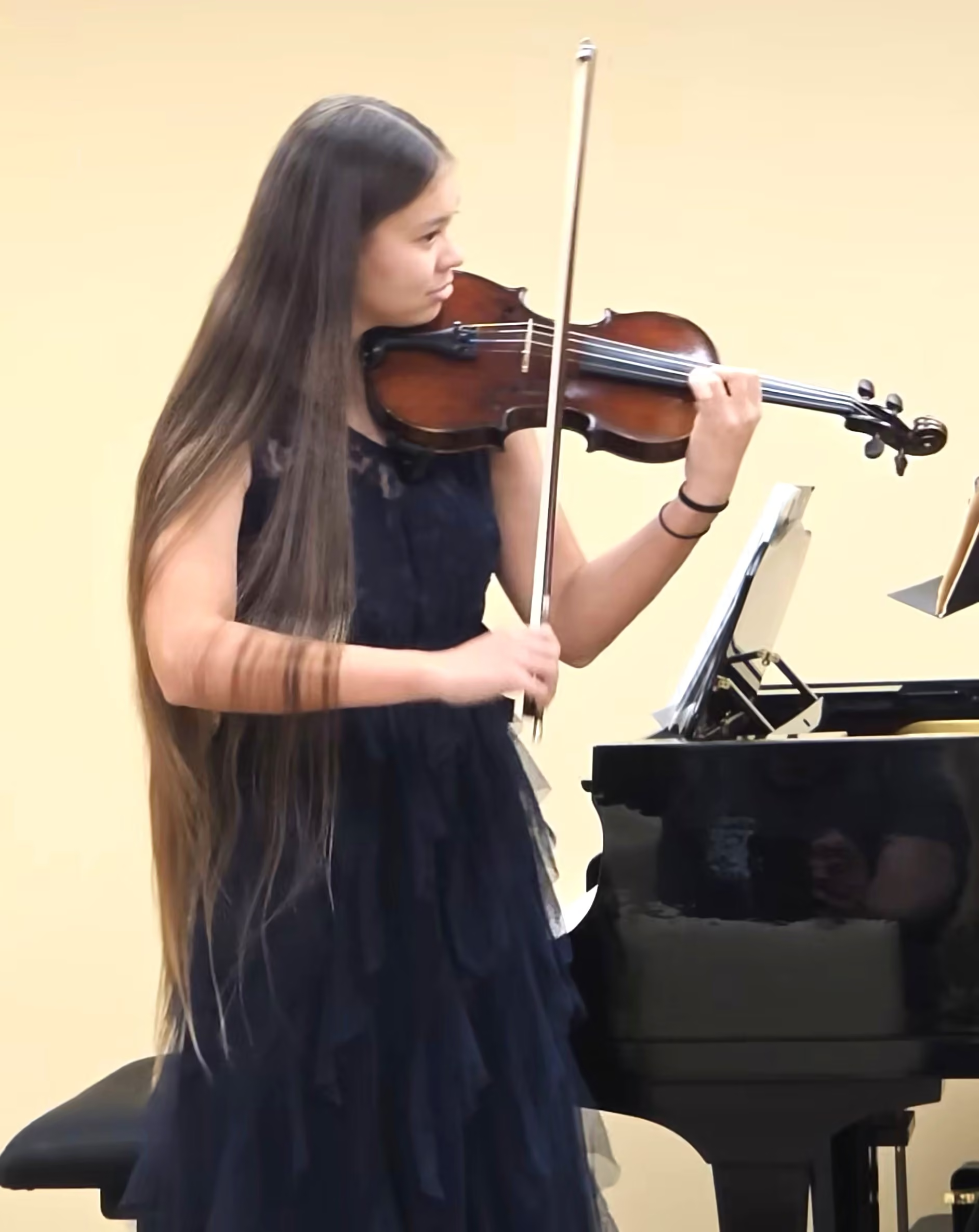
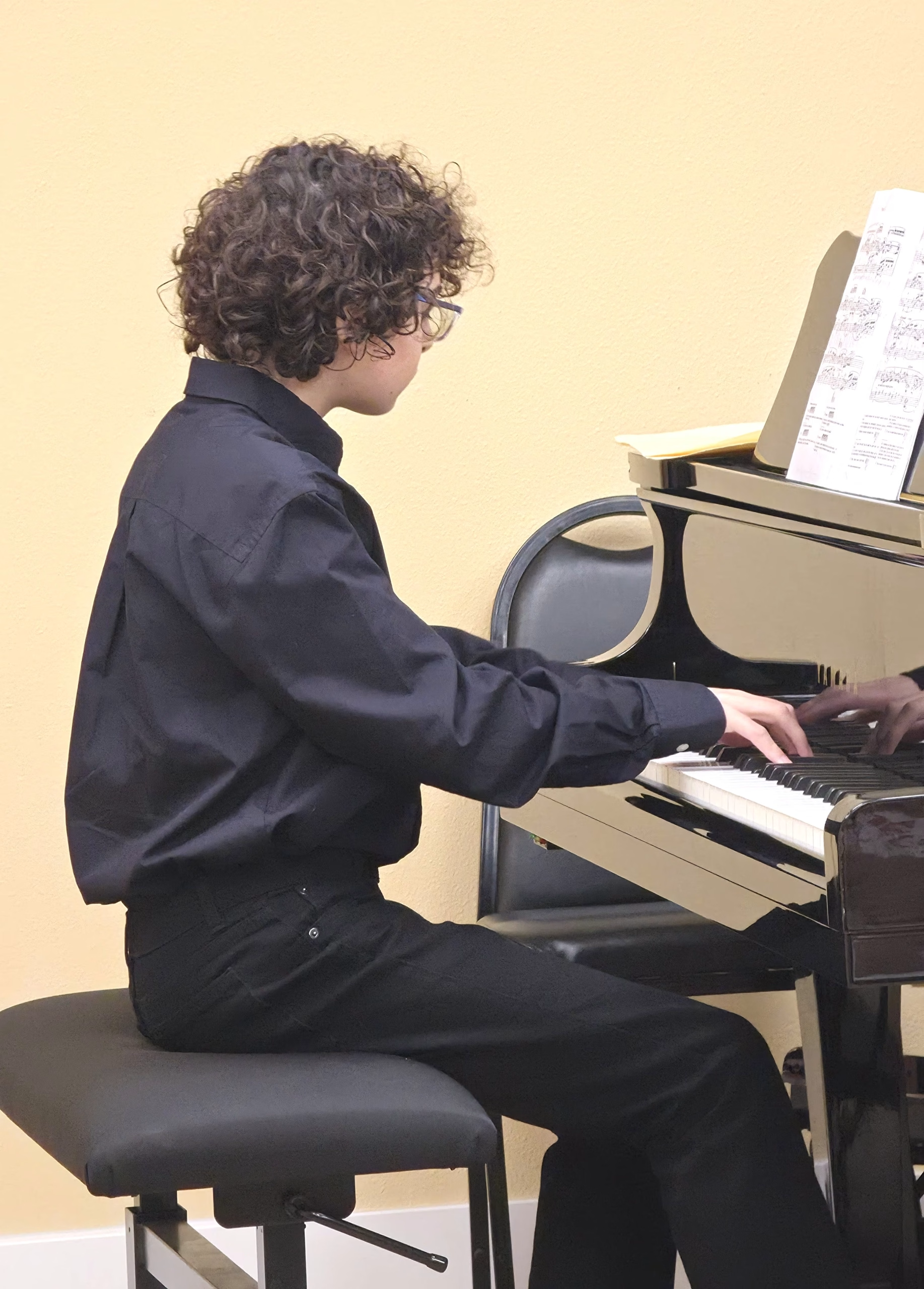
Older students feel the audience more. Choosing their own piece gives them some control back.
The youngest students
A four-year-old can bow and play eight bars. That is a real performance. Keep it under a minute.
The middle years
Ages 8 to 10 bring comparison. The child now grades themselves without being asked, so this is when process praise matters most.
Teenagers
For teens the pressure is social as much as musical. Let them choose the repertoire where the teacher agrees. Having some control reduces fear.
The child who cannot do it yet
Some children need another season. Stay on the lower steps of the audience ladder and try the recital next time. That is pacing, not failure.
Red Flags and When to Get More Help
| Normal nerves | Something bigger |
|---|---|
| Nervous before, relieved after | Panic that starts weeks ahead |
| Sleeps normally | Losing sleep over the recital |
| Willing to try again | Refusal that lasts a whole season |
| Symptoms only around performing | Stomachaches or worry at school and elsewhere too |
What a teacher can adjust
Tell the teacher early. They can change the difficulty of the piece, the place in the program, the size of the audience, and whether your child plays alone or with a partner.
When to involve a professional
If the right-hand column describes your child, and the worry shows up outside music as well, talk to your pediatrician. They can tell you whether a child therapist would help. The American Academy of Pediatrics has parent guides on childhood anxiety at HealthyChildren.org.
A music teacher can adjust the recital. They cannot treat anxiety, and should not be asked to.
What not to do
- Do not force a child onto a stage as a lesson in toughness.
- Do not promise a large reward before the performance. It raises the stakes.
- Do not compare them to a sibling who “just does it.”
Recital Season in San Diego
Most San Diego music schools hold winter recitals in December and spring recitals between April and June. Once you have a date, count back four weeks and start the plan above.
Five questions to ask a music school about recitals
- Is the recital required or optional?
- Is there a recital fee or an accompanist fee?
- How many students perform, and how long does it last?
- Can my child play with a teacher or a partner instead of alone?
- Can my child try the piano or the room before the day?
Keep it seasonal
Two performances a year suit most children. That is enough to build the skill and leaves months of ordinary lessons in between. If your child is beginning lessons in the new year, see our timeline for starting music lessons in January, which works toward a first spring recital.
Student Recitals at K&M Music School
K&M Music School is a 501(c)(3) nonprofit conservatory in Mira Mesa, about 15 minutes from La Jolla, UTC, Sorrento Valley, and Carmel Valley. Twelve teachers, 200+ students, 12 instruments, and 25 years in the same neighborhood.
A familiar room makes a calmer first recital.
What our students have on recital day
- Our own recital hall — on site, in the building where lessons happen
- Two grand pianos — a real concert instrument for every pianist
- No recital fee — performing is part of the program
- No accompanist fee — for violin, cello, voice, and wind students
- Every lesson is private — the teacher prepares your child one to one
- A written 9-level curriculum — pieces matched to your child's level
- A free trial lesson — no credit card required
Ask us at the trial lesson
If your child is nervous about performing, tell the teacher at the free trial lesson. Ask when the next recital is, how first-time performers are prepared, and what the options are for a child who is not ready yet. You will get a straight answer.
You can also read how often a child should take piano lessons, or browse all our music lessons.
Book a free trial lesson in Mira Mesa. Meet the teacher, see our recital hall, and ask how we prepare first-time performers. No credit card, no obligation.
Book Your Free Trial Lesson5703 Oberlin Dr, Unit 108, San Diego, CA 92121 (Mira Mesa) • 858-588-3938 • Explore all our music lessons
Quick Recap
A recital is a few minutes of discomfort that builds years of steadiness. The child learns that the body calms down, that the audience is kind, and that a mistake does not end the piece.
You cannot remove the nerves. You can make them familiar, make the preparation predictable, and make the conversation afterward kind.
Your next step: ask your child's teacher for the recital date, count back four weeks, and put the plan on the fridge.
Frequently Asked Questions
Do student recitals reduce stage fright in children?
Yes, over time. Each performance teaches a child that the nervous feeling rises, peaks, and passes. The body may still react, but children who have performed before usually dread the next performance less. Recitals make nerves manageable. They do not make them disappear.
Is stage fright normal for a child?
Yes. A racing heart, shaky hands, and a dry mouth are ordinary stress responses. Depending on the study, roughly one in five to one in two young music students report performance anxiety, and it tends to rise in the teenage years.
At what age can a child play in a recital?
Children as young as four or five can perform a very short piece, ideally with a teacher playing alongside. Keep it under a minute. Walking on, bowing, and playing eight bars counts as a real performance.
What should I say right before my child goes on stage?
Keep it to one sentence, such as: “I'm proud you're doing this, and I'll be right there.” Then stop talking. A long pep talk tells a child that something dangerous is about to happen.
What if my child freezes or makes a mistake on stage?
Plan for it in advance. Agree that if the music stops, your child takes a breath, starts again from an easy spot, or simply bows and walks off. A plan makes a freeze feel survivable instead of shameful. Afterward, comfort first and leave the critique to the teacher.
Should a nervous child skip the recital?
Skipping one recital is fine. Skipping every recital teaches avoidance, and the fear usually grows. A better option is a smaller step first, such as playing for two relatives at home or for one friend, and then trying the recital next season.
How long before a recital should my child start preparing?
The piece should be learned about four weeks before the date, so the final month is for run-throughs and practice performances. Many teachers choose a beginner's recital piece three to four months ahead.
Should I film my child's recital?
Record quietly from the back, or ask someone else to take one photo. A parent filming from the front row adds pressure to an already tense moment.
Do rewards help with recital nerves?
A small celebration afterward helps. A reward promised beforehand does not, because it raises the stakes and can sound like a bribe to a nervous child.