
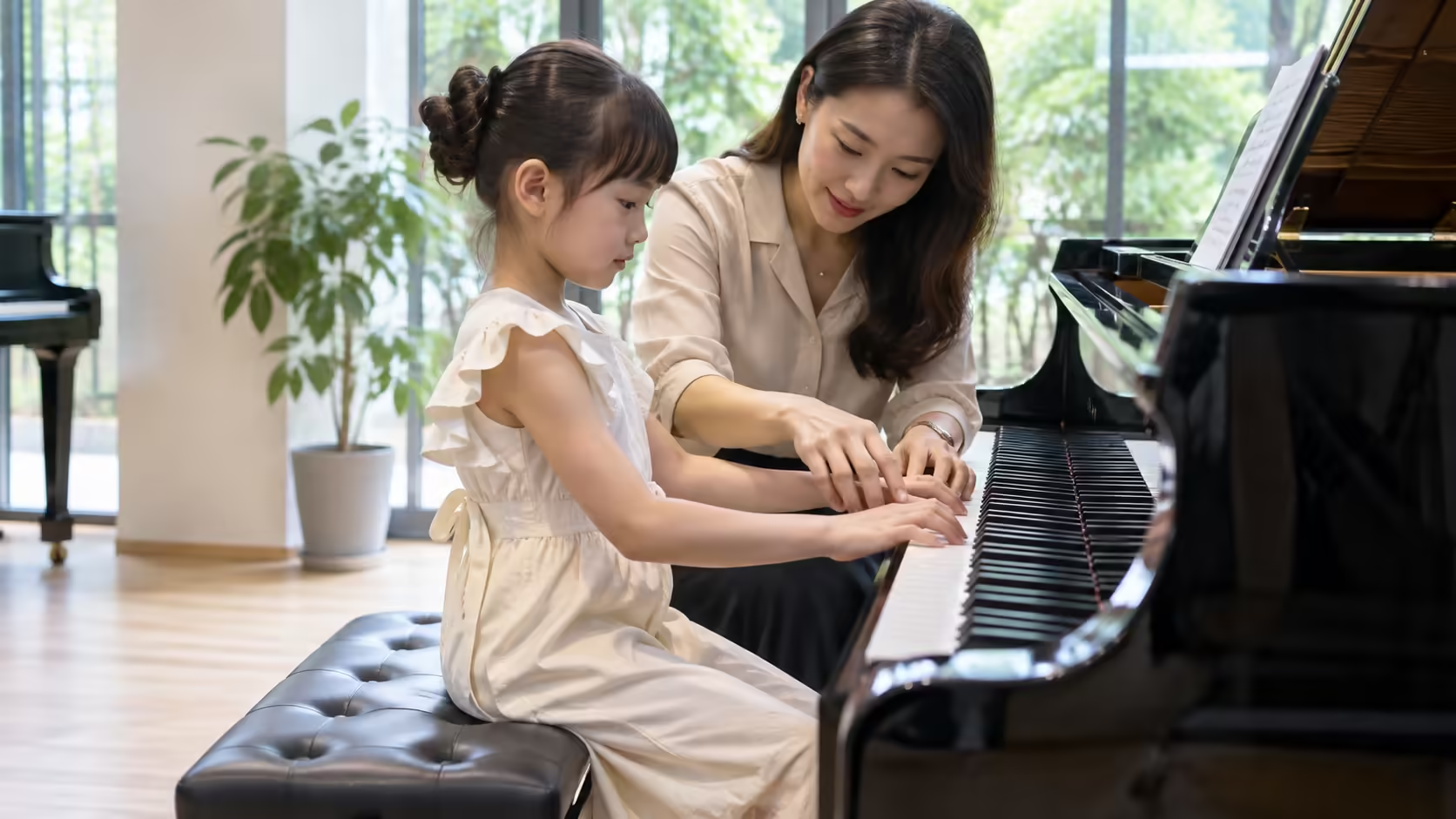

Short answer: In the first six months of piano lessons, most children learn to read notes in both clefs, count basic rhythms, play simple chords, use both hands together, and prepare one short piece they can perform.
A first song usually arrives within a few weeks. Hands-together playing starts around month three. By month six, you should hear a piece you would recognize from another room.
These are ranges, not deadlines. Age and daily practice shift every milestone, so compare your child to last month, not to another child.

The First Six Months of Piano Lessons at a Glance
Most parents picture month one and month six as the same lesson, just louder. They are not. In six months a child goes from hunting for middle C to playing a short piece with both hands, and the path between those two points is predictable.
| Skill | By month 2 | By month 4 | By month 6 |
|---|---|---|---|
| Reading music | Treble clef notes | Bass clef notes | Simple music for both hands |
| Rhythm | Quarter and half notes | Whole and dotted half notes | Eighth notes |
| Technique | Curved fingers, relaxed wrists | Five-finger patterns | Small hand shifts |
| Songs | 3–5 short songs | Simple two-hand songs | 5–8 pieces, one polished |
| Ear and theory | Loud and soft, high and low | Steps and skips | Major and minor sounds |
Quick answers
| Question | Answer |
|---|---|
| When will my child play a song? | Usually within a few weeks |
| How long should lessons be? | 30 minutes for most beginners |
| How much practice? | 5 to 20 minutes, five days a week, depending on age |
| When do both hands play together? | Around month 3 |
| When can my child perform? | Around month 6, with one prepared piece |
Treat these tables as a map, not a scoreboard. A younger child usually finishes about one beginner book level in six months. An older beginner often moves faster.
Before Month One: Readiness and Home Setup
Not every child starts from the same point. Five quick checks save months of struggle.
Five readiness signs
- Follows a two-step instruction without asking again
- Sits and pays attention for 15 minutes
- Knows left from right most of the time
- Can hum a simple tune back to you
- Reaches most white keys with a relaxed hand
Readiness decides the first lesson, not age. A child who cannot yet sit for 15 minutes will fight every practice session at home too.
What to set up at home
- A piano, or a digital piano with 88 weighted keys. Light keys teach the wrong touch.
- A bench at the right height, so elbows sit level with the keys.
- A music stand, good light, and a pencil.
- A quiet corner where the instrument stays out and visible.
What to skip in month one
Skip the expensive acoustic piano until the interest has lasted. Skip a year-long contract before a trial lesson. Skip adding a second instrument at the same time.
The First Six Months of Piano Lessons, Month by Month
For each month: what the teacher covers, what your child can do, what you will notice at home, and one question to ask.
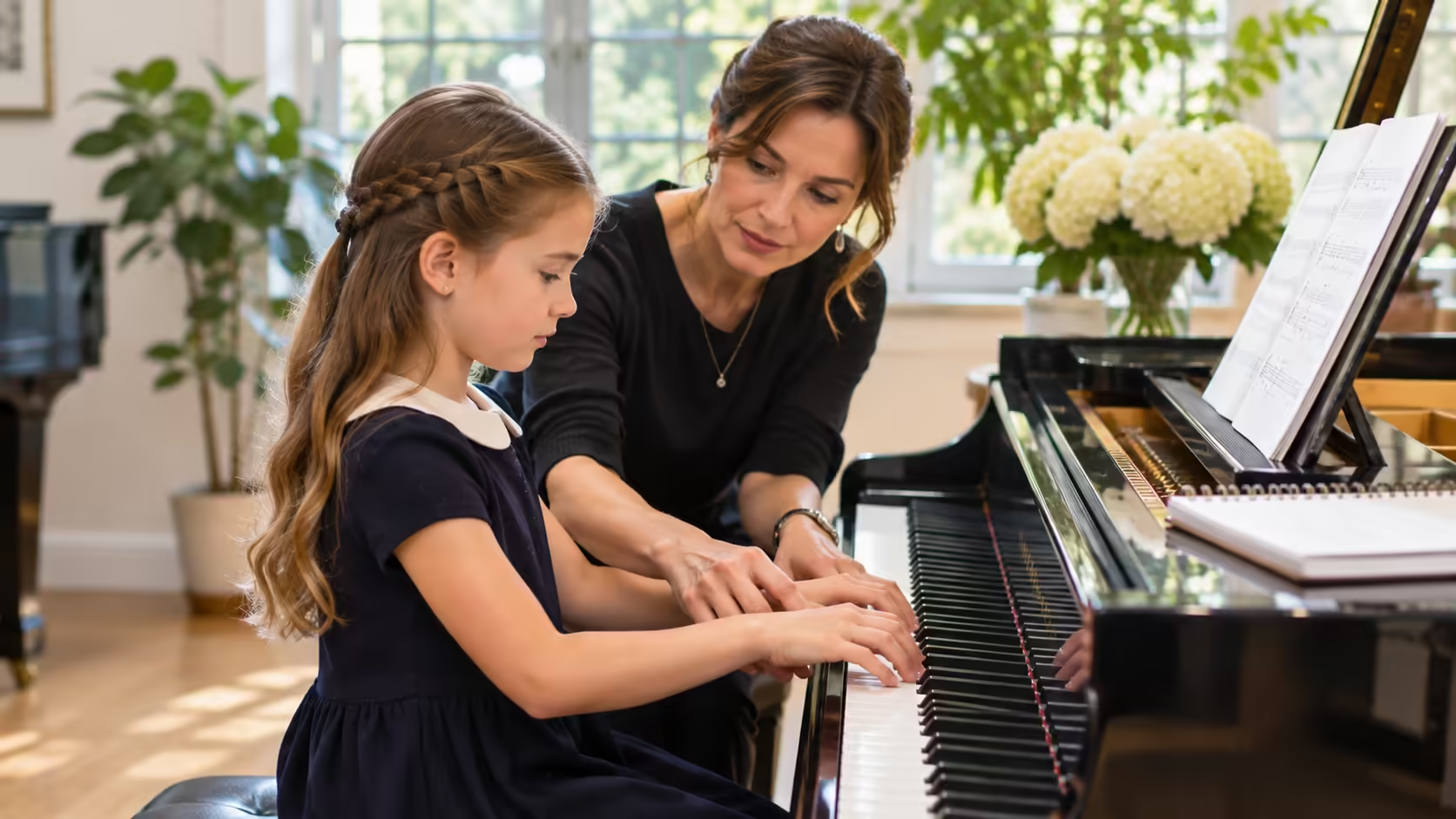
Month one is about posture and hand shape. Good habits are easiest to build before bad ones form.
Month 1 — Finding the keyboard and the beat
Teacher covers: where the notes are, high and low, loud and soft, posture, curved fingers, counting out loud.
Child can do: find middle C, play short patterns with one hand, clap quarter and half notes.
You will notice: lessons feel almost too easy. Many beginners play a simple song by the end of the month.
Ask the teacher: what is the plan for the first three months?
Month 2 — Notes on the staff and the first real tune
Teacher covers: reading treble clef notes, steps and skips, one-hand melodies with counted rhythm.
Child can do: read and play five-finger melodies and hold a steady beat while counting.
You will notice: the first recognizable song. Record it on your phone. It becomes your proof of progress in month five.
Ask the teacher: is my child reading the notes or memorizing the shapes?
Month 3 — Two hands together
Teacher covers: bass clef notes, hands-together coordination, dotted half notes, first changes in volume.
Child can do: play a piece slowly with both hands and keep the tempo.
You will notice: the first frustration. Hands that worked alone now argue with each other. This is the most common time for a child to say “this got hard.”
Ask the teacher: which hand should we practice first this week?
Month 4 — Chords and faster notes
Teacher covers: basic chords, eighth notes, slurs, and playing with expression.
Child can do: play chords in one hand and a melody in the other, and count eighth notes.
You will notice: a clear jump in how pieces sound. Progress becomes audible here, which helps motivation.
Ask the teacher: is my child ready for harder material, or should we stay and polish?
Month 5 — Musicianship appears
Teacher covers: phrasing, listening skills, and moving a simple pattern to a new key.
Child can do: shape a phrase from soft to loud and hear a wrong note.
You will notice: your child starts correcting their own mistakes. That is ear development, not attitude.
Ask the teacher: what should we prepare for a first recital?
Month 6 — The first performance-ready piece
Teacher covers: polish, memory work, performance habits, and a review of everything so far.
Child can do: play one piece from memory with both hands, at a steady tempo, with dynamics.
You will notice: a piece you would recognize from another room. That is the milestone worth celebrating.
Ask the teacher: what is the plan for the next six months?
Reading notes or memorizing shapes?
Some children get through the early pieces by memorizing where their fingers go, without reading the page.
It works until about month five, when pieces grow longer than memory can carry. Then progress stops suddenly. Asking this one question in month two lets the teacher fix it early.
Progress by Age in the First Six Months
The same six months produce very different results at different ages.
| Age | After six months | Typical goal |
|---|---|---|
| 5–6 | About halfway through a first book | Simple five-finger songs |
| 7–8 | Finishes a first book | Both hands, basic chords, one recital piece |
| 9–11 | Well into a second book | Hands together with eighth notes |
| 12–14 | Finishes a second book | Faster pieces with more expression |
| Adults | Second book or beyond | Quicker reading and stronger technique |
A five-year-old and an eleven-year-old can start the same book and finish it a year apart. That gap is not a flaw in the younger child. It is why comparing a six-year-old to a ten-year-old tells you nothing useful.
Compare your child to their own month-two recording. Never to another child in the waiting room.
The 10-Skill Checklist for the First Six Months
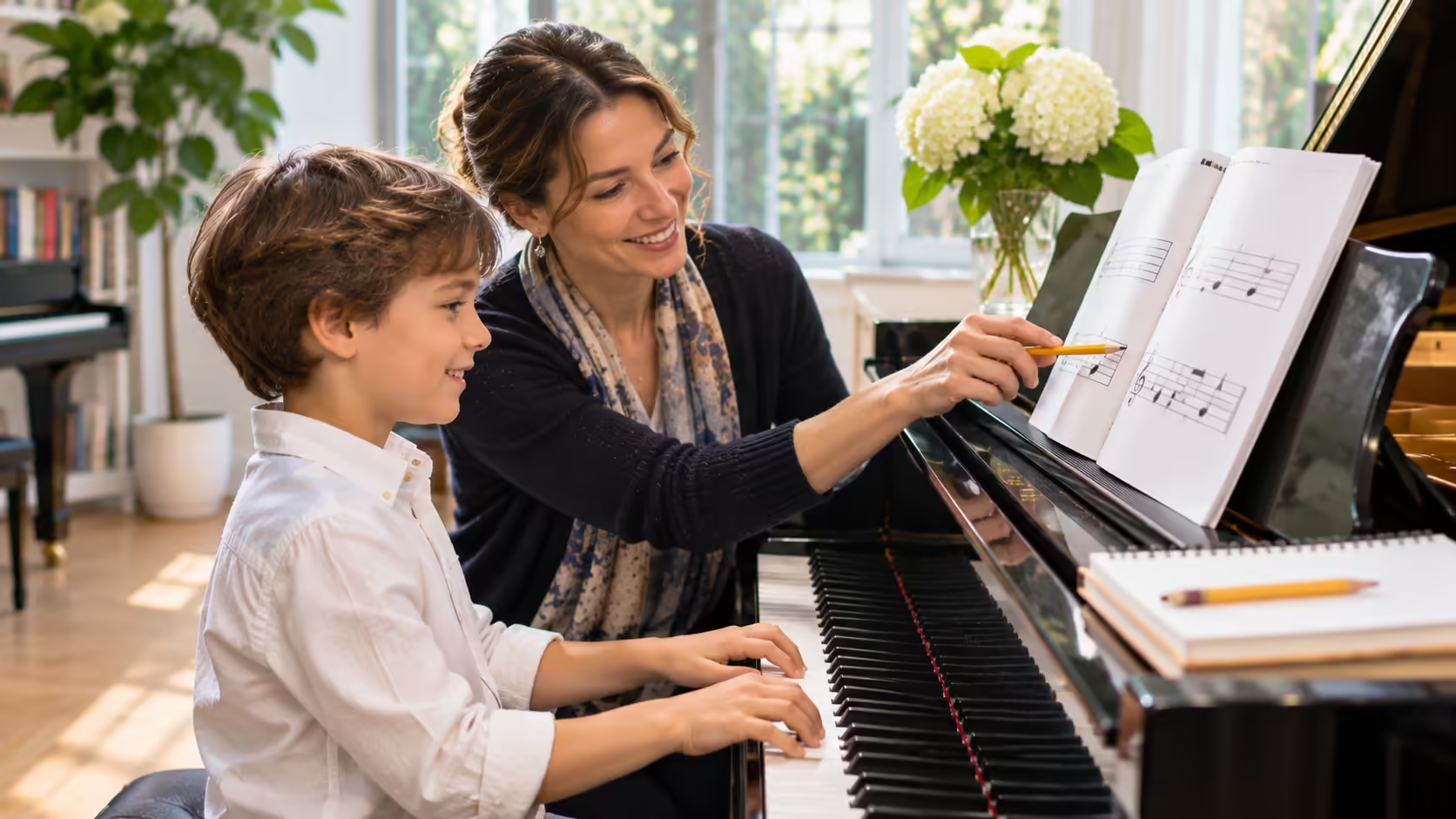
Note reading in both clefs is the skill that makes everything after month six possible.
Print this and tick it once a month
- Keyboard geography — finds middle C, knows high and low
- Posture and hand shape — curved fingers, relaxed wrists, feet supported
- Note reading — treble and bass clef notes around middle C
- Rhythm — quarter, half, whole, and dotted half notes, then eighth notes
- Technique — five-finger patterns and small hand shifts
- Chords — basic chords in one or two keys
- Hands together — both hands at a slow, steady tempo
- Dynamics — loud, soft, and getting gradually louder
- Ear and theory — steps, skips, repeats, major and minor sounds
- Performance habits — counts in, plays through a mistake, takes a bow
What is not expected in six months
- Fast scales. Real speed arrives in year two.
- Exam pieces. Most children reach a first graded exam after 18 to 36 months.
- Practice without reminders. That comes later.
- Perfect accuracy. Mistakes are what practice is made of.
How Much Should a Beginner Practice?
The number is smaller than most parents fear. Consistency does the heavy lifting.
| Age | Daily practice, five days a week |
|---|---|
| 4–6 | 5–10 minutes |
| 7–10 | 10–20 minutes |
| 11–13 | 20–30 minutes |
| Teens and adults | 30 minutes or more |
Five days is enough. Rest days help. Stop before your child is tired, not after. If attention breaks, split the time into two short sessions.
How to build one 15-minute session
- 2 minutes: warm-up with a five-finger pattern
- 5 minutes: the newest assignment, played slowly
- 5 minutes: review of last week's piece
- 3 minutes: one fun play-through of a favorite tune
What parents should do
Sit nearby for the first two weeks. Then step back, but stay within earshot. Ask “what did your teacher ask you to fix?” instead of “did you practice?” The first question gets a real answer.
Week four: the novelty fades. Almost every child loses some interest here.
Month three: hands-together playing begins, and it feels hard.
Neither one is a verdict. Change one thing: the practice time, the piece, or the practice spot. Then review at week eight before making any decision.
For more on lesson length and schedules, see how often a child should take piano lessons.
Method Books and Why the Order Matters
Good beginner teaching follows a sequence, not a pile of random songs. That sequence is what makes six-month progress measurable.
Many teachers use a published method series, such as Piano Adventures, Alfred's, Bastien, or Hal Leonard. Each has a lesson book, and some add theory and technique books. They cost about $9 to $10 each, and most beginners use two to four in the first half year. Ask your teacher which ones you need before buying a full set.
Other schools teach from their own written curriculum. Either approach works when the skills arrive in a sensible order.
The book matters less than the teacher. A strong teacher adapts the material to the child. A book cannot adapt itself. So ask a better question: how do you decide when my child is ready to move up a level?
Recitals and Exams: When to Add Them
The first recital
Most studios hold recitals between April and June. A child who starts in January has roughly 14 to 20 lessons before then, which is enough for one short piece. It does not need to be more than that. If your child is starting soon, our guide to starting music lessons in January has a full timeline.
Graded exams
Exam programs such as ABRSM, RCM, and California's Certificate of Merit test prepared pieces, scales, sight-reading, and listening skills together. Most children are ready for a first exam after 18 to 36 months, not six. Start exams only when reading and ear skills are both steady.
How to Tell If Piano Lessons Are Working
Check both lists at month three, and again at month six.
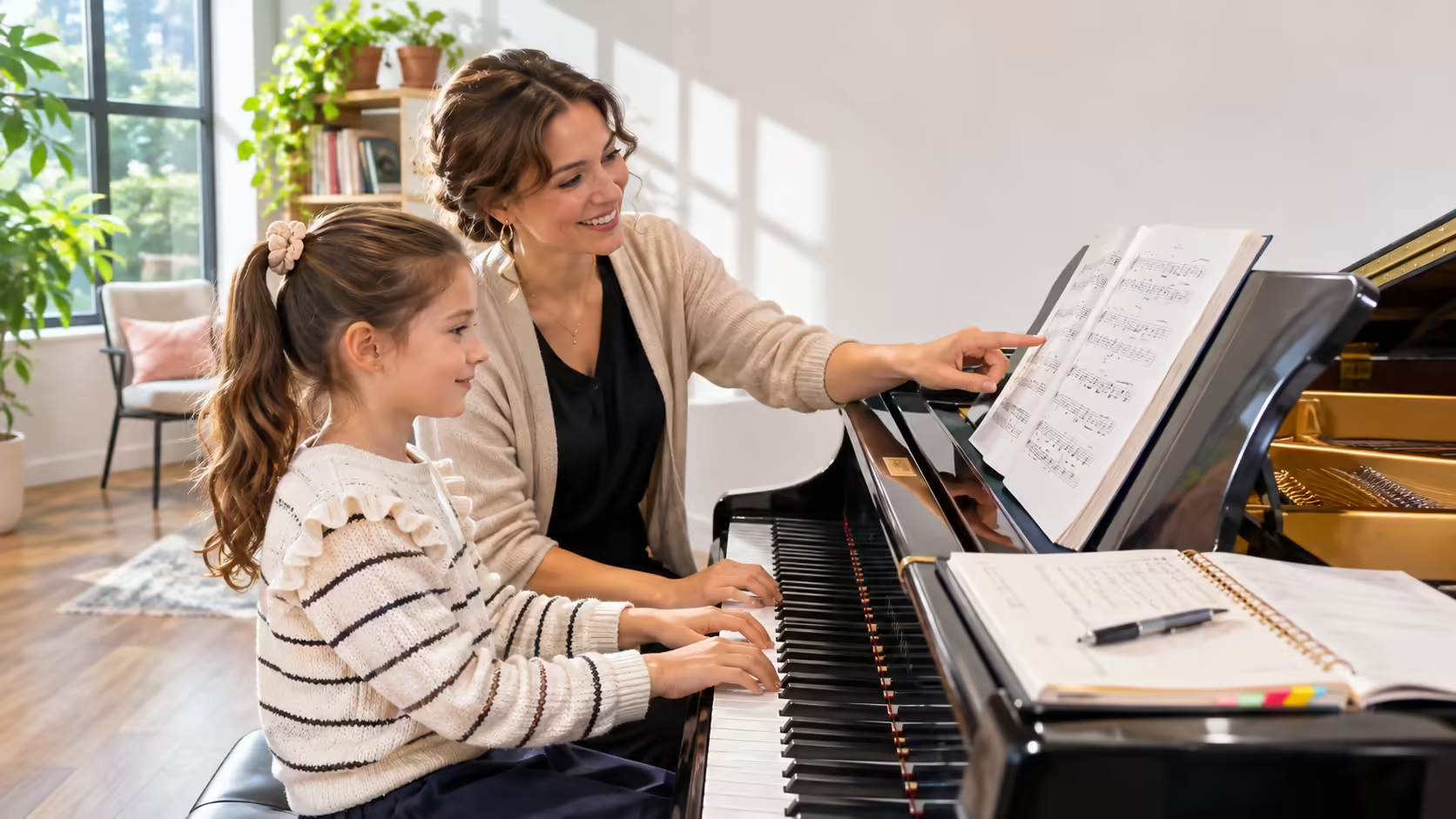
A child who can tell you what they are working on this month is a child whose lessons are working.
| Green flags | Red flags |
|---|---|
| Your child plays without being asked | Six months in, cannot find middle C without help |
| They notice and fix their own wrong notes | No written assignment comes home |
| Practice complaints drop after the first month | Lessons are mostly the teacher playing |
| The teacher gives specific next steps | No change of level, and no explanation why |
| They can name what they are working on | Cannot describe one thing learned last week |
The month-six conversation
Ask the teacher three questions:
- What has my child mastered?
- What is the next milestone?
- What should we practice this month?
A good teacher answers all three in under two minutes. A vague answer tells you something too.
What Beginner Piano Lessons Cost in San Diego
| Item | Typical cost |
|---|---|
| Private lesson, 30 minutes | $55–$85 per lesson, or $230–$340 a month |
| Private lesson, 45 minutes | $65–$95 per lesson, or $260–$380 a month |
| Beginner books | $9–$10 each, two to four in six months |
| Digital piano, 88 weighted keys | $400–$800 to buy, or $40–$150 a month to rent |
| Registration fee | $45–$95 at many schools |
A beginner needs the 30-minute lesson. Ask each school whether the registration fee is one-time or yearly, and whether recitals cost extra.
Where families save
- Buy a digital piano with weighted keys instead of an acoustic piano in the first year
- Ask the teacher which books are needed before buying a set
- Ask about sibling rates
- Borrow extra sheet music from the library
6 Common Parent Mistakes in the First Six Months
| Mistake | What to do instead |
|---|---|
| Correcting every note during practice | Sit nearby and correct rarely. Constant correction teaches dependence. |
| Comparing siblings | Compare each child to their own earlier recording |
| Buying an acoustic piano too early | Wait six months, then upgrade if your child still wants to continue |
| Skipping theory | Confirm the teacher includes it. Reading stalls in year two without it. |
| Changing teachers too fast | Three months is a fair trial. One awkward lesson is not a pattern. |
| Expecting a recital star by month three | A first recital fits six months of steady work |
Beginner Piano Lessons at K&M Music School
K&M Music School is a 501(c)(3) nonprofit conservatory in Mira Mesa, about 15 minutes from La Jolla, UTC, Sorrento Valley, and Carmel Valley. Twelve teachers, 200+ students, and 25 years in the same neighborhood.
A plan you can see, from lesson one.
Everything this guide tells you to ask a teacher for
- A written 9-level curriculum — skills introduced in a set order
- A written assignment every week — your child knows what to practice
- Theory and ear training included — part of the lesson, not an extra
- Every lesson is private — one student, one teacher
- A first recital in our own hall — two grand pianos, no recital fee
- Flat monthly tuition — the same in a 4-lesson or 5-lesson month
- A free trial lesson — no credit card required
What the free trial lesson tells you
In 30 minutes a teacher checks the five readiness signs, your child's hand size and posture, and how they respond to instruction. You leave knowing whether to start now or wait a few months, and what the first three months would cover. We also go through tuition with you, with every fee explained.
Our curriculum comes from the Russian conservatory tradition. You can read more about what conservatory-style lessons mean, or browse all our music lessons.
Book a free trial piano lesson in Mira Mesa. Meet the teacher, check readiness, and leave with a clear plan for the first three months. No credit card, no obligation.
Book Your Free Trial Lesson5703 Oberlin Dr, Unit 108, San Diego, CA 92121 (Mira Mesa) • 858-588-3938 • Explore all our music lessons
Quick Recap
Six months takes a child from finding middle C to playing a piece with both hands. Expect note reading in both clefs, five-finger patterns, simple chords, steady counting, and one polished piece. Expect a dip in week four and another in month three. Both pass.
Your next step: print the ten-skill checklist and tick it once a month. Bring it to your month-six conversation with the teacher, and ask what comes next.
Frequently Asked Questions
What should a child learn in the first six months of piano lessons?
In six months most beginners learn to read notes in both clefs, count basic rhythms, play five-finger patterns and simple chords, use both hands together, and prepare one short piece for performance. Younger children usually finish about one beginner book level in that time, and older beginners often move faster.
How fast should a 6-year-old progress on piano?
A six-year-old is usually about halfway through a first beginner book after six months, with 5 to 10 minutes of practice on five days a week. Younger students take longer through each level by design, so compare your child to their own earlier playing, not to an older child.
When will my child play with both hands?
Most beginners start playing hands together around month three. It is also the most common point for frustration, because hands that worked alone now have to coordinate. Slow practice of each hand separately gets a child through it.
How much should a beginner practice piano?
Five days a week is enough. Plan 5 to 10 minutes a day for ages 4 to 6, 10 to 20 minutes for ages 7 to 10, and 20 to 30 minutes for ages 11 to 13. Short daily sessions work better than one long session at the weekend.
Do we need a piano, or is a keyboard fine?
A digital piano with 88 weighted keys and a sustain pedal works well for the first years. A light, unweighted keyboard teaches the wrong touch, and that habit takes months to undo.
How do I know if my child has a good piano teacher?
Look for a written assignment every week, a clear book or curriculum level, specific corrections instead of vague praise, and a plan for the next three months. A good teacher can tell you what your child has mastered and what comes next in under two minutes.
What if my child wants to quit in the first few months?
Expect a dip around week four, when the novelty fades, and another around month three, when hands-together playing begins. Change one thing first, such as the piece, the practice time, or the practice spot, and review at week eight before deciding.
When should a child start graded piano exams?
Usually after 18 to 36 months of lessons. A first graded exam tests prepared pieces, scales, sight-reading, and listening skills together, so it makes sense only once reading and ear skills are both steady.
Can a child learn piano online for the first six months?
Partly. Online lessons work for note reading and rhythm. Posture and hand shape need in-person correction, so young beginners do better with a teacher in the room.
How much do beginner piano lessons cost in San Diego?
Private 30-minute piano lessons generally run $55 to $85 each, or roughly $230 to $340 a month for weekly lessons. Add beginner books at about $9 to $10 each, usually two to four in the first half year.


