What is a Cello?

Katherine Dvoskin Co Founder of K&M Music School
I hope you enjoy this blog post! If you're interested in scheduling a free trial lesson, just click.
Author: Katherine Dvoskin | Co-Founder of K&M Music School
Published September 21st , 2024

The cello is a large string instrument. It has four strings and is played with a bow. The main parts are the body, neck, strings, and bow. You sit to play the cello, resting it between your knees. The left-hand presses on the strings to change the notes. The right hand moves the bow across the strings to make a sound. Sometimes, you can also pluck the strings with your fingers. The cello can play high and low notes, making it versatile. With practice, you can learn to play beautiful music on this instrument.
Have you ever listened to a symphony orchestra and heard the rich, warm sound of the lower strings? Chances are that the sound is coming from the cello section. The cello produces a beautiful tone that forms the bass foundation of any ensemble. But what exactly is a cello? Let’s explore the basics of this iconic instrument.
| Instrument Basics | Historical Highlights | Notable Brands |
|---|---|---|
| Large string instrument | Originated in 16th century Italy | Stradivari |
| Played with a bow | Evolved from viola da gamba | Amati |
| Four strings | Perfected by 1700 | Montagnana |
| Rich, warm bass tone | Gained popularity in 18th century | Boccherini |
| Sits between player's knees | Romantic era brought showpieces | Yo-Yo Ma (performer) |
| Made of wood (spruce, maple) | Modern designs use carbon fiber | Janos Starker (performer) |
| F-shaped sound holes | Endpin introduced around 1850 | Mstislav Rostropovich (performer) |
The cello, or violoncello, is part of the violin family. It is a string instrument. Like the violin, it has strings and is played with a bow. However, the cello is bigger and plays lower notes. It is the bass member of the family, larger than the violin and viola. A cello has a curved, hollow body with an attached neck, pegbox, and scroll. Modern cellos also have an endpin that supports the weight of the instrument.
So in simple terms, a cello is a large four-stringed instrument that is played with a bow. But there’s so much more to the cello than just its physical attributes! In this guide, we will go over the basics of the cello. This way, you can learn about this awesome instrument. Let’s start with where it comes from and its history.

Origin and History
Before diving further into what a cello is, let’s learn about where it came from. The earliest cellos emerged in Northern Italy in the mid-to-late 16th century. Early makers of cellos based them on the viola da gamba. This was another string instrument that was popular during the Renaissance.
Over the next 200 years, cello makers slowly decided on its shape and size. This gave the cello its well-known look today. By 1700, it established its place as the bass voice of the modern string quartet. And the rest is history!
In the 18th century, composers started adding more cello solos to their music. Cellists like Luigi Boccherini and Jean-Baptiste Bréval used new techniques. Because of this, the cello became more exciting and complex.
The Cello’s Predecessors
To fully understand the origins of the cello, it helps to examine some of its predecessors. The viola da gamba family emerged in the 15th century as a new form of stringed instrument. Early cellos had six or seven strings. Even though the cello and bass gamba are different, the cello learned from the bass gamba. They introduced new styles and techniques. Because of this, playing the cello became more interesting. As a result, the cello became more fun to play. They used new techniques. So, the cello became more interesting. They introduced new techniques. As a result, the cello became more exciting. They used new techniques. Because of this, the cello became more exciting.

Luthiers made gambas in different sizes, from treble to bass, like a consort. But they were quite different in construction from modern stringed instruments. Gambas had flat backs and fretted fingerboards like guitars. Musicians held them vertically between the legs to play.
By the start of the Baroque era, people’s tastes began to change. The modern violin family, with its curved backs and no frets, became more popular. As a result, gambas were used less. However, some features of the bass gamba were used in a new instrument, which became the cello.
The cello and the bass gamba started differently. However, the cello benefited from the bass gamba’s design. So, the cello improved because of ideas from the bass gamba. Because of this, the cello improved and evolved. The cello blended the best aspects of old and new string technology. Its versatile design allowed the instrument to flourish through modern times.
Cello Timeline: Key Developments
Now let’s trace some of the major milestones in early cello history:
| Year | Key Developments |
|---|---|
| c. 1550 | The earliest known cellos emerged in Northern Italy, likely based on the bass viola da gamba. |
| Early 1600s | Cello-making centers develop in Cremona and Brescia. The first cello sonatas are written. |
| Late 1600s | The cello establishes its place as the bass voice of the modern string quartet. |
| 1680s | Important innovations to cello design made by famed luthier Antonio Stradivari. |
| 1700 | Torelli composes the first concerto for cello. Instruments grow very popular throughout Europe. |
| 1740 | Famous Venetian maker Domenico Montagnana made his first cellos. His work influenced many future cello makers. Because of this, his designs are still important today. |
| c. 1750-70 | Cello virtuosity expands greatly, including new performance techniques. |
| 1800s | Romantic era brings even more brilliant showpieces for cello and orchestra. |
This timeline shows how quickly new ideas made the cello popular. The cello started gaining popularity after it was created in the mid-1500s. Because of these innovations, the cello became well-known. Let’s explore some of these key developments in more detail.

The Cello Takes Shape
Early cello pioneers like the Amati family worked to refine the instrument’s form. Other early makers included Girolamo II Amati and his son Nicolo. They experimented with details like the cello’s proportions, arching, and f-hole placement.
But the luthier Antonio Stradivari perfected the cello’s now classic shape. He determined the ideal contouring, thickness graduation, and varnishes. Stradivari made cellos with a deep, rich sound. Today, makers still try to copy this sound.
Stradivari made about 1,100 instruments, but only around 70 were cellos. These cellos set the standard for design. Famous cellists like Yo-Yo Ma, Janos Starker, and Mstislav Rostropovich still play them. They are valued for their amazing sound.
Virtuoso Showpieces Expand Technique
Luigi Boccherini wrote and performed very difficult solo pieces to show off his amazing skills. He included challenging cello parts in his larger ensemble works, like his quintets. Playing across three or four strings shows the cello’s flexibility. This ability makes the cello a versatile instrument.
These showpieces inspired cellists to expand their technical and expressive capabilities. Later Romantic composers continued that tradition. Their brilliant concertos exploited the cello’s singing tone and range to thrilling effect.
What Does a Cello Look Like?
Now that we know some history, let’s look at the parts that make up a cello. We will break down its main features one by one. A cello has three main parts – the body, the neck, and the pegbox/scroll.

The Body
The body of a cello is large and has a rounded back that tapers to narrow shoulders. On the front, cellos have two f-shaped sound holes placed on either side of the strings. The hollow body construction allows the cello’s sound to amplify and resonate.
Cellos come in various sizes, but most are the standard 4/4 (full-size). Larger 3/4 and smaller 1/2, 1/4, and even 1/8-sized cellos exist for younger students. Advanced cellists may also use a larger 7/8 size for added projection.
Regardless of size, all cello bodies follow the same basic shape and construction. The front, back, and sides are typically made from solid wood like spruce and maple. But some modern cellos feature alternate materials like carbon fiber. The type of wood and materials impact the instrument’s tone and durability.
Let’s examine the different parts of the cello body and how they’re made:

The Top
The top plate (or front) of a cello is traditionally made from spruce wood. Two f-shaped sound holes cut into the top allow vibrations to emanate freely from the body. Spruce is lightweight yet strong, providing excellent resonance across the cello’s range.
- The wood grain runs vertically to handle the downward pressure of the strings and bridge.
- Top plates are 2-4mm thick and get thinner from the center to the edges.
- The bass bar is added underneath and runs along the bass side of the bridge.
The Back
The back plate forms the rounded side that sits against the cellist. Nearly all backs are made from maple wood. Occasionally other hardwoods like poplar or willow substitute when maple is scarce. Like the top, the back vibrates as the instrument plays.
- Its curved shape contributes strength to withstand the cello’s tension.
- The wood grain also runs vertically on the back to handle pressure.
- Luthiers carefully carve the arching to taper from thick in the center down to thin at the sides.
- Master makers like Stradivari created the perfect contouring, thickness graduation, and flexibility.
The Ribs
The ribs connect the top to the back plate along the cello’s sides. Most ribs are also maple to match the back. Ribs help transfer vibrations around the body. Their slim, arched profile provides enough stiffness without weighing down the body.
- Rib sections attach one at a time to an inner block and lining structure.
- Modern cellos have six or seven ribs in total.
- Some makers bend ribs using heat and pressure for better resonance.
- High-quality ribs and their precision fit impact the cello’s volume and tone.
Listen to Our Podcast
If you’d like to learn more about what is cello, tune into our podcast where we share expert tips and insights. Check it out on our YouTube channel and elevate your music journey today!
The Scroll
Perched atop the neck sits the decorative scroll. It caps off the pegbox which houses the tuning pegs. Scroll shapes vary from plain to highly ornate. Simple scrolls feature basic volutes while more extravagant turnings have detailed carving.
- The scroll may depict anything from floral shapes to mythical creatures.
- Many feature the traditional scroll shape with a large spiral.
- Scroll designs get passed down through generations of luthiers.
- Certain styles are linked to cities like Cremona and Venice, where many skilled makers worked.
- The scroll serves no acoustic purpose and is purely decorative. But it makes the cello easily recognizable. It also lets makers show their skill by carving this delicate piece of wood. This adds beauty to the cello.
The F-Holes
The two f-shaped sound holes visible on a cello’s top facilitate vibration. They allow air movement and sound projection without compromising structural integrity. Their shape and placement evolved over centuries of cello-making.
- Inhalation Stage:
- The diaphragm muscle drops downward, allowing the lungs to expand outward.
- Intercostal muscles between the ribs expand the rib cage.
- This expansion creates negative pressure, drawing large volumes of air into the lungs.
- Exhalation Stage:
- The diaphragm and intercostals relax.
- The diaphragm moves upward, forcing air out of the lungs.
- Abdominal muscles compress inward, pushing out the remaining air.
- The positive pressure allows controlled expulsion of plosive sounds like “P” and “B”.
Baroque luthiers originally used circular or crescent-shaped holes. Later makers found the f-shape enhanced the instrument’s tone and volume. The holes sit on either side of the bridge, aligned with the outer notches. This allows each string to vibrate freely. The area between the f-hole and bridge is made thicker because it needs to handle the most pressure.
The inside hollow body acts as a resonating chamber. Sound waves from the vibrating strings transmit through the f-holes into the body. Then they reflect off the back plate, amplifying as they interact with the top. The tone projects outward through the f-holes into the surrounding air.
Varnish
The exterior varnish finish on a cello gives it visual beauty while protecting the wood. Nearly all stringed instruments get some type of protective clear coating. But only the highest quality cellos have fine hand-rubbed varnish.
- After carving the body, luthiers apply multiple layers of specially formulated oil varnishes.
- They cure each coat before adding the next.
- Multiple thin layers allow flexibility and vibration.
- Alcohol-based spirit varnishes provide a harder finish but can hinder resonance.
- The ingredients and colors of varnishes changed throughout history. The golden orange hues preferred by Italian makers later shifted to red and brown. Modern cellos may have natural transparent or colored opaque finishes. But original varnish recipes remain a closely guarded secret passed down through generations.

Music Lessons in San Diego with K&M Music School
Expert Music Lessons
We offer Piano, Violin, Cello, Saxophone, Bassoon, Harp, Voice, and Toddler group lessons for students of all ages and skill levels.
Why Choose Us?
- 🎶 Boosts focus and self-discipline
- 🎵 Strengthens cognitive skills
- 🎼 Enhances cultural understanding
- 🎤 Builds confidence through recitals and performances
We Welcome Adults Too!
Book Your Free Lesson NowThe Purfling
The thin inlaid strip of wood encircling the top plate is called purfling. It forms an attractive border around the f-holes and provides more than just decoration. The purfling helps protect the delicate soundboard from cracks due to pressure.
- Purfling is made from three thin strips of wood, usually maple or ebony, glued together.
- The luthier carefully places the purfling into a shallow groove around the cello’s body.
- Then, they attach the top plate. Precise workmanship ensures a clean seam.
- Besides adding decorative appeal, the purfling also limits crack propagation. If the top plate wood starts to split, the purfling helps stop the crack from spreading. This keeps the damage from spreading. If the soundboard stays intact, the cello can keep its great sound.
The Neck
The long fingerboard sits on top of the cello’s neck. It’s usually made from ebony wood. The cellist presses the strings down onto the fingerboard to change pitches. The fingerboard goes past the neck and onto the body of the cello. This lets the cellist play higher notes on the instrument.
At the base of the neck sits the cello’s bridge. The strings pass over the tall bridge which allows them to vibrate freely. Cellists can adjust a bridge to fine-tune the string height and intonation.
The Fingerboard
The fingerboard is a long, narrow piece of wood glued atop the neck that the strings run over. Ebony is the most common fingerboard wood thanks to its hardness and smooth texture. But some cheaper cellos may use alternative dense woods.
- A curved fingerboard allows the strings to vibrate freely when played.
- The cellist presses the strings down to the wood to change the pitch.
- The fingerboard extends slightly over the top plate, enabling very high notes.
- Fingerboards attach to a wider surface called the neck root along with the nut.
- Pegs or screws anchor them together through the side of the neck.
- Playing over the years eventually leads to divots and indentations in the fingerboard.
- Luthiers occasionally plane and re-finish them to restore a smooth surface.

The Nut
The nut is a small sliver of wood located where the fingerboard meets the pegbox. The nut has four shallow slots. These slots guide the strings down the fingerboard to the bridge. The notches in the nut keep the strings from buzzing and help them vibrate clearly.
- Nuts often match the fingerboard wood, usually ebony or rosewood.
- Bone, ivory, brass, or plastic are also common materials.
- The height of the nut slots decides how high the strings are above the fingerboard.
- Luthiers carefully adjust the nut height using special tools.
- The nut helps the strings stay in place and makes sure notes sound clear when played open. Over time, the nut can wear out. So, it might need to be replaced or fixed to keep the strings spaced correctly.
The Bridge
The bridge transfers vibrations from the strings into the cello body. It sits centered along the lower bout of the front plate. The feet extend over the f-holes, contacting the thicker soundboard area. Cellists adjust a bridge’s position to achieve proper string height and tone.
- Bridges are traditionally hand-carved from quality maple.
- Versions made from carbon fiber and other modern materials exist too.
- The top holds notches that strings pass over before anchoring at the tailpiece.
- These notches are critical for precise string spacing and intonation.
- Two adjustable feet at the base balance the bridge.
- Cellists tune by turning thumbwheels to raise or lower each side independently.
- Fine tuners on the tailpiece make minor adjustments.
- Bridges help send energy from the strings to the cello. They also affect the sound quality and how loud the cello is. This depends on how heavy and flexible the bridge is.
Occasionally, bridges collapse if the soundpost inside shifts. When experts move the soundpost to the right place, the bridge can send energy into the cello again. This helps the cello sound good. Otherwise, the cello won’t project sound well.
The Endpin
The endpin screws into the bottom block inside the lower back plate. When extended, it makes contact with the floor to support the cello’s weight. Endpins are typically made of steel or carbon fiber. They can be adjustable to suit players of different heights. For traveling, endpins screw back flush into the cello.
Prior to endpins, cellists would clamp spikes or pins to the bottom edge of the instrument. But this damaged the soft wood. The first extendable endpins emerged around 1850. Initially, they faced resistance for being too modern! But adjustable endpins caught on when players realized they improved posture and technique.
Now endpins are universal cello accessories. They allow players of all ages to hold the instrument at the proper height. Endpin stops or anchors prevent over-tightening. Rubber caps protect floors and provide traction. Using endpins improved the ergonomics of cello playing immensely.

Internal Structures
The outside shape gives the cello its look. Inside parts help keep the instrument strong and stable. Let’s examine them:
Bass Bar
The bass bar is an interior brace made of spruce that runs nearly the cello’s full length. It attaches to the underside of the top plate just behind the bass-side f-hole. By adding stiffness, it helps counteract string tension on that side of the bridge. Bass bars gradually taper in height and width towards both ends.
- Their purpose is to transmit vibration from the strings throughout the top plate.
- The bass-side G and C strings generate the most power and low frequencies.
- The bass bar prevents this energy from distorting the top plate.
- It also influences the direction of sound waves in the body chamber.
- Bass bars undergo custom fitting for each instrument. The height, position, and angles all impact the cello’s tone and strength.
- Some modern bars have an arched shape too for even energy distribution.
- Replacing warped or cracked bars can restore a cello’s projection and clarity.
Soundpost
The soundpost is a small dowel inside the cello connecting the front and back plates. It sits under the treble side of the bridge centered between the f-holes. Soundposts help transmit vibrations through the bridge into the body. They are custom fit to the correct height and thickness – usually around 6-8mm in diameter.
- Spruce and maple are typical soundpost woods.
- Their flexibility and light weight keep from dampening vibrations.
- Movements of the bridge cause the post to oscillate rapidly.
- This transfers the strings’ energy without hindering resonance across the cello’s range.
- If a soundpost falls, the cello loses most projection.
- Expert luthiers “set” posts in the ideal location to balance tone and strength.
- The bridge’s positioning also relates to soundpost placement underneath. Together they must work harmoniously to ensure optimal sound production.

The Cello: A Symphony of Parts and History
Throughout this exploration of the cello, we’ve journeyed from its origins in 16th-century Italy to the intricate details of its construction. We’ve discovered:
- The cello’s evolution from early string instruments like the viola da gamba
- The crucial developments by master luthiers like Stradivari
- The complex anatomy of the cello, from its body to its strings
- The importance of each component, from the visible scroll to the hidden soundpost
Each part of the cello, whether seen or unseen, plays a vital role in creating its distinctive sound. The craftsmanship that goes into making a cello is a testament to centuries of musical innovation and artistic dedication.
As we’ve seen, the cello is not just an instrument but a piece of living history, continually adapting to the needs of musicians and composers across genres and eras. Its versatility and rich tone have secured its place in both classical orchestras and contemporary ensembles.
With this understanding of the cello’s complexity and significance, we can now appreciate why it has endured as a beloved instrument for centuries.
Conclusion
The cello, with its rich history and versatile capabilities, has evolved from a 16th-century Italian creation to a cornerstone of modern music. Its unique construction produces a warm, resonant tone that spans bass to tenor ranges, making it invaluable in classical orchestras and contemporary genres alike.
Key points:
- Versatility: From bass lines to solos, the cello excels in various musical roles
- Craftsmanship: Centuries of innovation have perfected its design
- Enduring appeal: Popular across genres and generations
Whether you’re a beginner or an experienced player, the cello offers a lifetime of musical exploration. Its timeless sound continues to inspire musicians and captivate audiences, securing its place in the ever-evolving world of music.
Music Lessons in San Diego with K&M Music School
Expert Music Lessons
We offer Piano, Violin, Cello, Saxophone, Bassoon, Harp, Voice, and Toddler group lessons for students of all ages and skill levels.
Why Choose Us?
- 🎶 Boosts focus and self-discipline
- 🎵 Strengthens cognitive skills
- 🎼 Enhances cultural understanding
- 🎤 Builds confidence through recitals and performances
We Welcome Adults Too!
Book Your Free Lesson NowCall-to-Action
Ready to take your cello to the next level? Start by incorporating techniques into your daily practice. Explore more cello training resources or consider taking cello lessons with a professional cello coach to further refine your skills!
Frequently Asked Questions
What are the cello’s dimensions?
Full-size cellos range from 75-80 cm from neck to tailpiece. The top and back width spans 35-40 cm at the widest bout. Full cellos stand up to 120-130 cm floor to scroll. Fractional sizes scale down proportionally.
What musical roles does the cello play?
The cello most often plays the bass line in ensembles like orchestras and quartets. But it can also play melody lines thanks to its expansive range. Film scores often feature the cello’s singing tone.
Why do cellists sit to play?
Sitting helps cellists hold the cello steady. They use their inner thighs and knees to balance the cello. This lets them use both hands for tricky bowing and finger movements. Sitting also facilitates vibrato and shifting to higher positions.
How much does a high-quality cello cost?
Professional-grade cellos range from $20,000 to $200,000+ USD. Many professionals play antique cellos worth over $1 million. But beginner and intermediate student models start under $1,000.
What cello strings do professionals use?
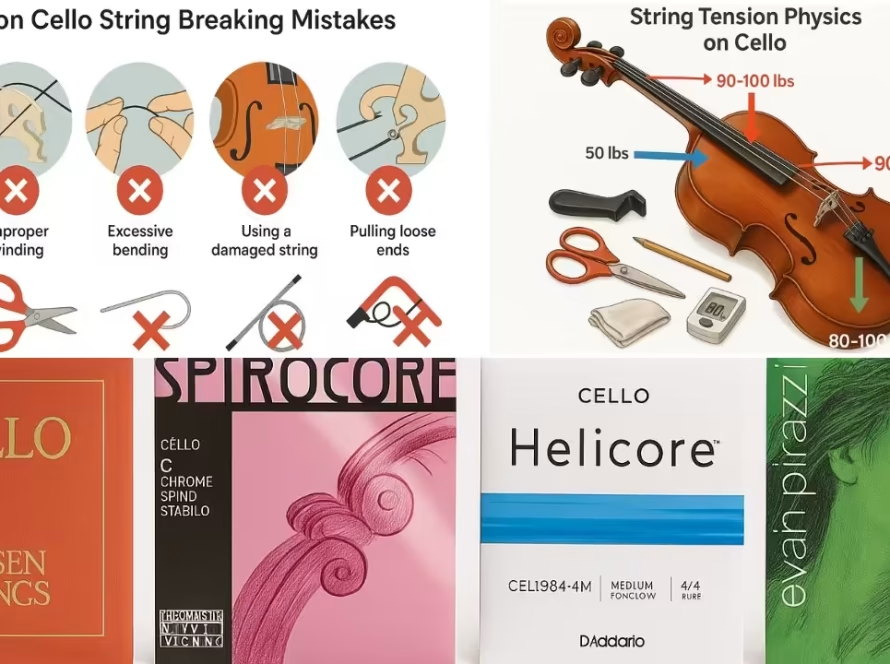
Many cellists combine steel core or synthetic core strings for A, D & G with a wound steel or gut C string. Brands like Larsen, Spirocore, and Versum are popular. Strings affect tone quality and playing feel.
Do cellists use endpins and why?
Endpins help elevate cellos to the proper playing height for seated cellists. Prior to their adoption around 1850, cellos had to be clamped between the knees. Endpins improved posture, technique, and tone production.
How often do cellists change strings?
Professionals change cello strings every few months. This keeps the tone, pitch, and playability in good shape. Students may change their strings every 6-12 months. Replacing old strings brings new life to the instrument.
Katherine Dvoskin Co Founder of K&M Music School
She is co-founder of K&M Music School in San Diego, is a passionate music educator with over 25 years of experience. She offers expert piano lessons in San Diego. At K&M Music School, we teach Piano, Violin, Cello, Saxophone, Bassoon, Harp, Voice, and Toddler group lessons. Katherine's blog shares insights on music education, covering topics from toddler music group lessons to adult music lessons. Whether you're seeking private music lessons or group music lessons for toddlers near you, welcome to K&M Music School.