What is a Cello – Understanding Its History and Evolution
Katherine Dvoskin Co Founder of K&M Music School
I hope you enjoy this blog post! If you're interested in scheduling a free trial lesson, just click.
Author: Katherine Dvoskin | Co-Founder of K&M Music School
Published September 10th , 2024
Introduction
The cello, a versatile bowed string instrument, started a long time ago and has undergone significant evolution. Its shape and design have developed over time. Now, the cello is famous in classical music, jazz, cello rock, and pop. Because of this, it is used in many different musical genres.
The cello is a popular instrument in orchestras and chamber music groups. It plays a big role in these ensembles. Because of this, it is very important in European classical music and Western music. If you’re new to playing, check out how to choose a great starter cello on a budget.
| Cello Essentials | Historical Milestones | Notable Figures |
|---|---|---|
| Bowed string instrument | Originated in 16th century Italy | Andrea Amati: First cello maker |
| Played seated, between knees | Perfected by 1700s in Cremona | Antonio Stradivari: Improved design |
| Rich, warm tone | Gained popularity in Baroque era | Pablo Casals: Revitalized techniques |
| Versatile: solo, ensemble, bass roles | Expanded to jazz, rock, pop in 20th century | Yo-Yo Ma: Genre-crossing virtuoso |
| Key parts: body, neck, strings, bow | Electric cellos introduced | The Beatles: Featured in "Eleanor Rigby" |
Tracing the Early Origins of the Cello
The cello’s full history started in Northern Italy in the 1500s. It evolved from earlier bass instruments in the violin family, such as the viola da gamba. These early string instruments were used for bass in Renaissance music.
As musical styles changed from the Renaissance to the Baroque era, a new bass instrument was needed. In the mid-1500s, famous violin maker Andrea Amati, one of the most renowned instrument makers, crafted the first true cello in Cremona, Italy. This early cello was smaller than modern cellos and had higher bridges. However, it established the basic design for the cello we use today.
Over the next hundred years, cello makers worked to improve the instrument. In Antonio Stradivari’s workshop in Cremona around 1700, two significant changes were made:
- He introduced a wider tapered cello body shape with rounded corners, amplifying the instrument’s projection across all registers.
- He placed the endpin screw at the bottom, allowing the cello to stand freely on the floor.
These changes made the cello louder and gave it its famous shape. By the early 1700s, makers in cities like Cremona and Venice had perfected the cello. Their high-quality instruments from this time are still the most wanted and copied today by modern cello makers. Our blog post on perfecting posture and technique is a great resource for beginners.
Music Lessons in San Diego with K&M Music School
Expert Music Lessons
We offer Piano, Violin, Cello, Saxophone, Bassoon, Harp, Voice, and Toddler group lessons for students of all ages and skill levels.
Why Choose Us?
- 🎶 Boosts focus and self-discipline
- 🎵 Strengthens cognitive skills
- 🎼 Enhances cultural understanding
- 🎤 Builds confidence through recitals and performances
We Welcome Adults Too!
Book Your Free Lesson NowAnatomy of the Cello – What Makes Its Unique Sound?
The cello has special parts that contribute to its warm, rich sound. Here are the main components of this incredible instrument:
- Body: Larger than a violin, with an hourglass shape and two large “f” holes. Made of thin maple wood (front and back) and spruce or willow (sides).
- Neck: Long, made of maple with a carbon fiber rod for extra strength. Tilted with a raised fingerboard.
- Scroll: Decorative curved part at the end of the cello’s neck, usually made from the same piece of maple as the neck.
- Pegs: Located in the pegbox, used for tuning each string. Typically made of ebony or rosewood.
- Bridge: Transmits string vibrations to the body. Features a slight curve (camber) for free string vibration.
- F-holes: Two f-shaped openings with rounded edges that help the sound resonate and project.
- Tailpiece: Anchors the strings at the bottom, working with the pegs to maintain string tension and tuning.
- Endpin: Retractable spike at the bottom that supports the cello and allows it to stand upright.
- Strings: Originally made from traditional gut string. Now, most cellos use steel or synthetic strings with metal windings.
- Fine tuners: Small adjusters on the tailpiece for precise pitch control.
All these parts work together to produce the cello’s distinctive sound. The materials and construction techniques significantly influence the instrument’s tone quality. Learn more about maintaining the sound quality of your instrument in our guide on cello tuning.
Playing Position and Bowing Technique
Before delving into the cello’s storied history, it’s essential to understand how cellists play this instrument. Unlike the violin, which is held under the chin, the cello is played sitting down.
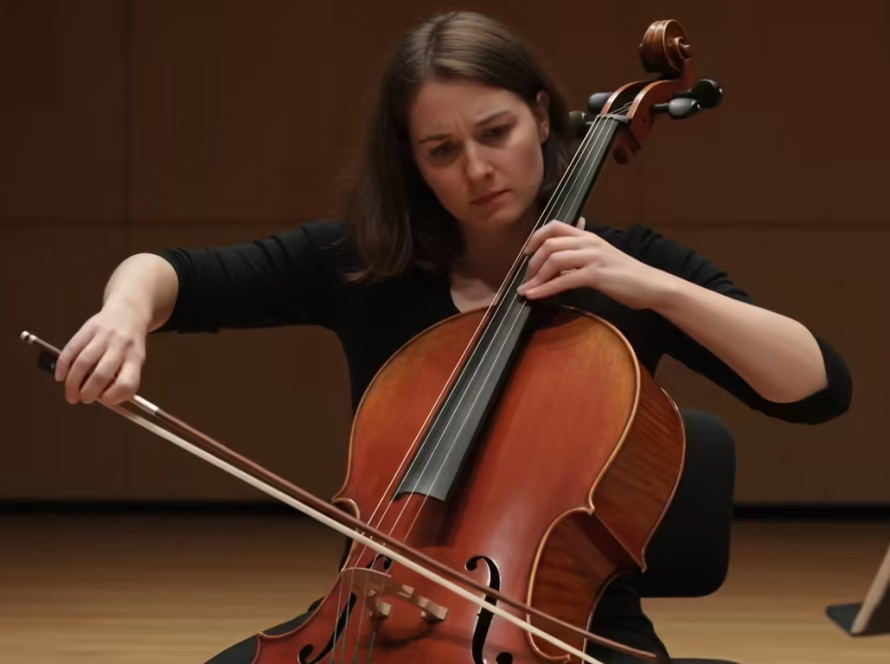
The cellist places the instrument between their knees, with the endpin resting on the floor. They sit on a chair without armrests, holding the cello at an angle across their body. The knees and chest help keep it steady.
The left-hand presses the strings against the fingerboard to create different notes, a technique known as fingering. Meanwhile, the right-hand draws the bow across the strings, producing a continuous, smooth sound.
Cellists use various bowing techniques to create different sounds and expressions:
- Long, sustained notes (legato)
- Short, detached notes (staccato)
- Bouncing the bow (spiccato)
- Rapid string crossing (bariolage)
These techniques, combined with variations in bow speed, pressure, and contact point, allow cellists to produce a wide range of tones, from soft, elegant phrases to powerful, dramatic statements. If you’re looking to perfect your bowing, explore common pizzicato problems and how to fix them.
The Cello Secures Its Prominent Role in Classical Music
By the early 18th century, the cello had established itself as a crucial instrument in classical music. Famous works by Vivaldi and other Baroque composers popularized the cello. Later in the 1700s, the cello took on various roles in music:
- Solo instrument: Featured in concertos and sonatas, demonstrating its capacity for complex melodies and virtuosic display.
- Rhythm section: Providing a rhythmic foundation in orchestras and chamber ensembles, similar to the double bass.
- Tenor Voice: In its middle register, mimicking the human tenor voice in ensemble settings.
- Bass voice: Supporting harmonic structures, similar to an organ’s pedal tone.
Music Lessons in San Diego with K&M Music School
Expert Music Lessons
We offer Piano, Violin, Cello, Saxophone, Bassoon, Harp, Voice, and Toddler group lessons for students of all ages and skill levels.
Why Choose Us?
- 🎶 Boosts focus and self-discipline
- 🎵 Strengthens cognitive skills
- 🎼 Enhances cultural understanding
- 🎤 Builds confidence through recitals and performances
We Welcome Adults Too!
Book Your Free Lesson NowExamples of the Cello Excelling in Each Role:
Solo Cello Masterpieces
- Vivaldi’s cello concertos
- Haydn’s Cello Concertos in C and D
- Elgar’s Cello Concerto in E minor
- Shostakovich’s Cello Concertos No. 1 and 2
- Bach’s and Britten’s cello suites
Rhythmic Cello Parts
- Beethoven’s 5th and 9th symphonies
- Bizet’s Carmen – “Habanera” bassline
- Rossini Overtures
- Ballet and opera music
Singing Tenor Voice
- Tchaikovsky’s ballets
- R. Strauss’ Don Quixote
- Barber’s Adagio for Strings
Bass Foundations
- Beethoven & Brahms Symphonies
- Strauss Waltzes
For a deeper dive into the cello’s role in orchestras, read about the warm sounds of the cello and how it enhances orchestral compositions.
Iconic Orchestral & Chamber Works Featuring Cello
The cello’s role extends beyond solo performances. It’s an integral part of chamber music and orchestral compositions, adding depth and richness to these ensembles.
In the Baroque period, Bach wrote Six Cello Suites for solo cello. Vivaldi used the cello in many of his string concertos, including The Four Seasons.
During the Classical Era, Haydn composed two cello concertos and included important cello parts in all 104 of his symphonies.
In the Romantic Era, composers like Mendelssohn, Chopin, Brahms, and Dvořák wrote piano trios and string quartets featuring prominent cello parts.
Today, the cello continues to appear across various musical styles:
Orchestral Works
- Symphonies by Beethoven, Tchaikovsky, Mahler, Shostakovich
- Ballets: Swan Lake, Romeo & Juliet, The Nutcracker
- Operas: Bizet’s Carmen, Puccini’s Tosca
- Film Scores: John Williams often features cello melodies and solos
Chamber Groups
- String Quartets: Beethoven, Schubert, Shostakovich, Glass
- Piano Trios: Haydn, Chopin, Rachmaninoff
- Piano Quartets & Quintets: Brahms, Dvořák
Thanks to its expressive tone, the cello fits seamlessly alongside violin, viola, piano, winds, and voice in various musical compositions. Interested in playing chamber music? Explore the differences between violin and cello difficulty and decide which is right for you.
Legendary Cellists That Shaped Cello Repertoire
Many great cellists have expanded the cello’s capabilities through their performances, recordings, and collaborations with legendary composers.
Early Virtuosos
- Luigi Boccherini: Italian composer and cellist who elevated the cello as a solo instrument.
- Jean-Louis Duport: French cellist and composer who pioneered new virtuosic playing techniques.
- Bernhard Romberg: German cellist and composer who wrote important practice books for cellists.
Classical Era Giants
- Jean-Baptiste Bréval: Top cellist in Gossec’s orchestra, premiered many new concertos.
- Anton Kraft: Austrian cellist admired by Beethoven.
- Joseph Franz Weigl: One of the first cellists to play solo concerts and taught many students.
Romantic Virtuosos
- Alfredo Piatti: Italian cellist who toured globally and composed challenging cello music.
- David Popper: Bohemian cellist who wrote instructional music to improve cello technique.
- Gregor Piatigorsky: Russian cellist who commissioned works from famous composers like Prokofiev and Poulenc.
20th Century Innovators
- Pablo Casals: Spanish cellist who revitalized cello techniques and recorded the first complete Bach Cello Suites.
- Mstislav Rostropovich: Russian cellist and conductor who commissioned over 100 new cello works.
- Yo-Yo Ma: American cellist known for his diverse repertoire and cross-genre collaborations.
Contemporary cellists like Sheku Kanneh-Mason and Alisa Weilerstein continue to push the boundaries of cello performance and repertoire. For those inspired by the legacy of great cellists, consider taking private cello lessons to develop your own skills.
Cello’s Growing Popularity in Jazz, Rock, Pop & World Music
While the cello has deep roots in classical music, it has also found a place in contemporary genres, including jazz, rock, pop, and world music.
Cello in Jazz
Jazz cellists have pioneered new techniques, expanding beyond the instrument’s classical origins:
- Oscar Pettiford: Used the cello for walking basslines and solos.
- Harry Babasin: Early jazz pioneer who played with Benny Goodman.
- Erik Friedlander: Uses special techniques and improvisation for unique sounds.
With the advent of electric cellos and portable pickups, jazz cellists can now perform on stage or in studios while maintaining great sound quality.
Cello in Rock & Pop Music
The cello has made notable appearances in rock and pop music since the 1960s:
- The Beatles: “Eleanor Rigby” features an octet of cellos.
- Led Zeppelin: “Stairway to Heaven” incorporates cello to enhance the acoustic guitar sound.
- Nirvana: Their MTV Unplugged concert featured cello, adding a unique dimension to their sound.
Conclusion
The cello’s journey from its origins in 16th century Italy to its current status as a versatile, beloved instrument is a testament to its unique sound and expressive capabilities. Its rich history, shaped by legendary composers, famous instrument makers, and virtuoso players, has secured its place in both traditional and contemporary music. From baroque concertos to modern rock ballads, the cello continues to captivate audiences with its deep, resonant tone, proving its enduring appeal across the whole music field. Start your own cello journey by exploring our guide to cello lessons in San Diego.
Music Lessons in San Diego with K&M Music School
Expert Music Lessons
We offer Piano, Violin, Cello, Saxophone, Bassoon, Harp, Voice, and Toddler group lessons for students of all ages and skill levels.
Why Choose Us?
- 🎶 Boosts focus and self-discipline
- 🎵 Strengthens cognitive skills
- 🎼 Enhances cultural understanding
- 🎤 Builds confidence through recitals and performances
We Welcome Adults Too!
Book Your Free Lesson NowCall to Action
- Explore the cello’s diverse repertoire by listening to works from different periods and genres.
- Consider taking cello lessons – many music schools offer both private music lessons and group music lessons.
- Attend a cello recital or symphony orchestra concert to experience the instrument’s power live.
- Visit a national music museum to learn more about the cello’s history and see historic instruments.
- Share your favorite cello piece or performer in the comments, and join the conversation about this magnificent instrument.
Sign up for a free trial cello lesson.
Frequently Asked Questions
What are the main parts of the cello?
The cello’s main components include the body, neck, scroll, pegs, bridge, f-holes, tailpiece, endpin, and strings. Each element contributes to the instrument’s unique sound.
Why did the cello become so popular in western music?
The cello gained popularity due to its versatility in playing both melodies and harmonies. Its rich, warm tone appealed to composers and audiences alike, leading to its prominent role in orchestras and chamber music.
How is the cello played?
Cellists play seated, holding the instrument between their knees. The left hand presses the strings to create different notes, while the right hand moves the bow across the strings to produce sound.
What’s the difference between a cello and a violin?
While both are string instruments, the cello is much larger than a violin and is played sitting down. It produces lower, deeper tones and often plays bass lines in orchestral music.
Can the cello be used in non-classical music?
Yes, the cello is increasingly used in jazz, rock, pop, and world music. Many contemporary musicians are exploring innovative ways to incorporate the cello into various genres.
Katherine Dvoskin Co Founder of K&M Music School
She is co-founder of K&M Music School in San Diego, is a passionate music educator with over 25 years of experience. She offers expert piano lessons in San Diego. At K&M Music School, we teach Piano, Violin, Cello, Saxophone, Bassoon, Harp, Voice, and Toddler group lessons. Katherine's blog shares insights on music education, covering topics from toddler music group lessons to adult music lessons. Whether you're seeking private music lessons or group music lessons for toddlers near you, welcome to K&M Music School.